
Introduction – Why Starting a Startup in India Is a Great Opportunity
India has become one of the world’s leading startup ecosystems, offering exciting opportunities for entrepreneurs, innovators and business owners. With growing digital adoption, government initiatives, access to technology and increasing investment opportunities, starting a business has become more accessible than ever.
Whether you are planning to launch a technology company, e-commerce platform, consultancy, manufacturing unit or service-based business, understanding how to register a startup in India is an important first step.
Proper business registration provides a legal foundation, improves business credibility and helps entrepreneurs establish clear ownership and management structures. Choosing the right business structure is equally important because it affects taxation, liability, investment opportunities and compliance requirements.
In this guide, BSG & CO explains how to register a startup in India, including business structures, eligibility, documents, incorporation procedures, DPIIT recognition, registration expenses and post-incorporation compliance.
What Is a Startup?
A startup is a newly established business that develops a product, service or business model to solve a particular problem or fulfil a market requirement. Startups generally focus on innovation, growth and scalability.
Unlike traditional businesses, which may concentrate on serving a specific local market, startups often aim to expand their operations and reach larger customer groups.
Examples include:
- Technology and software development companies.
- E-commerce businesses and online marketplaces.
- Fintech and financial technology platforms.
- Healthcare and education technology companies.
- Innovative manufacturing businesses.
- Digital marketing and consulting companies.
- Sustainable products and service businesses.
However, every newly established business does not automatically qualify for DPIIT Startup Recognition. Eligible entities must satisfy the applicable government conditions relating to incorporation, turnover, innovation and scalability.
Different Types of Business Structures for Startups in India
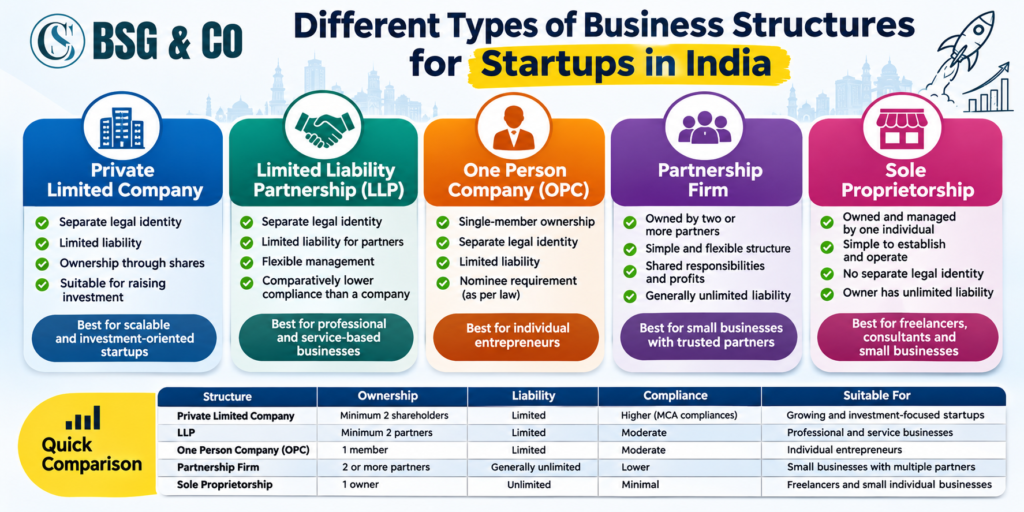
Before deciding to register a startup in India, entrepreneurs should understand the available legal structures. Each structure has different ownership, liability and compliance requirements.
-
Private Limited Company
A Private Limited Company is a popular choice for entrepreneurs planning business expansion and external investment.
Advantages include:
- Separate legal identity.
- Limited liability for shareholders.
- Ownership through shares.
- Suitable structure for attracting investors.
- Better flexibility for future equity funding.
It generally requires at least two shareholders and two directors.
Suitable for: Technology startups, e-commerce businesses and companies planning to raise venture capital.
-
Limited Liability Partnership (LLP)
An LLP combines the flexibility of a partnership with limited liability protection.
Its advantages include:
- Separate legal identity.
- Limited liability for partners.
- Flexible management structure.
- Different and generally lighter compliance requirements than companies.
An LLP requires at least two partners and two designated partners.
Suitable for: Consulting firms, agencies, professional services and service-based businesses.
-
One Person Company (OPC)
An OPC allows an eligible individual to establish a company with a single member.
Key features include:
- Single-member ownership.
- Separate legal identity.
- Limited liability.
- Nominee requirement under applicable law.
Suitable for: Individual entrepreneurs seeking a corporate business structure.
-
Partnership Firm
A partnership firm is established when two or more individuals agree to operate a business and share profits.
It offers simple management and flexible business arrangements. However, partners generally have unlimited personal liability.
Suitable for: Small businesses operated by multiple partners.
-
Sole Proprietorship
A sole proprietorship is owned and managed by one individual. It is comparatively simple to establish and operate.
However, it does not have a separate legal identity from its owner. The proprietor is personally responsible for business liabilities.
Suitable for: Freelancers, individual consultants and small retailers.
Comparison of Business Structures
| Business structure | Ownership | Liability | Suitable for |
| Private Limited | Minimum 2 shareholders | Limited | Growing startups |
| LLP | Minimum 2 partners | Limited | Professional firms |
| OPC | 1 member | Limited | Individual entrepreneurs |
| Partnership | 2 or more partners | Generally unlimited | Small businesses |
| Proprietorship | 1 owner | Unlimited | Individual businesses |
Eligibility Criteria to Register a Startup in India
Indian entrepreneurs can establish businesses by selecting an appropriate legal structure and fulfilling its incorporation requirements.
However, ordinary business registration and DPIIT recognition have separate eligibility conditions.
General Incorporation Requirements
- Private Limited Company: Generally requires two shareholders and two directors.
- LLP: Requires at least two partners and two designated partners.
- OPC: Requires one eligible member and a nominee.
- Partnership: Requires at least two partners.
DPIIT Startup Recognition Eligibility
Under the revised DPIIT notification dated 4 February 2026, the general eligibility conditions include:
- Eligible entity: Private Limited Company, registered partnership firm, LLP or eligible cooperative society.
- Age: Generally not more than 10 years from incorporation or registration.
- Turnover: Should not exceed ₹200 crore in any financial year since incorporation or registration.
- Innovation: Must work towards innovation, development or improvement of products, processes or services, or operate a scalable business model with employment or wealth-generation potential.
- Originality: Must not be formed by splitting up or reconstructing an existing business.
Eligible Deep Tech Startups can receive an extended recognition period of up to 20 years and a turnover limit of ₹300 crore, subject to the applicable conditions.
A sole proprietorship and OPC are not eligible entity structures under the general DPIIT recognition framework.
Documents Required to Register a Startup in India
Preparing documents in advance makes the incorporation process smoother.
Founder and Director Documents
- PAN card.
- Aadhaar card or other accepted identity proof.
- Residential address proof.
- Passport-size photographs, where required.
- Email address and mobile number.
- Digital Signature Certificate (DSC), where applicable.
Registered Office Documents
- Electricity bill or utility bill.
- Rent agreement or ownership proof.
- No Objection Certificate from the property owner, where applicable.
- Complete registered office address.
Business Incorporation Documents
- Proposed company or LLP name.
- Business activity details.
- Details of directors, shareholders or partners.
- Proposed shareholding structure.
- Memorandum of Association (MOA).
- Articles of Association (AOA).
- LLP agreement, for LLP registration.
Additional declarations and supporting documents may be required depending on the business structure and founders’ residential status.
Step-by-Step Process to Register a Startup in India
Understanding the incorporation procedure helps entrepreneurs complete each stage correctly.
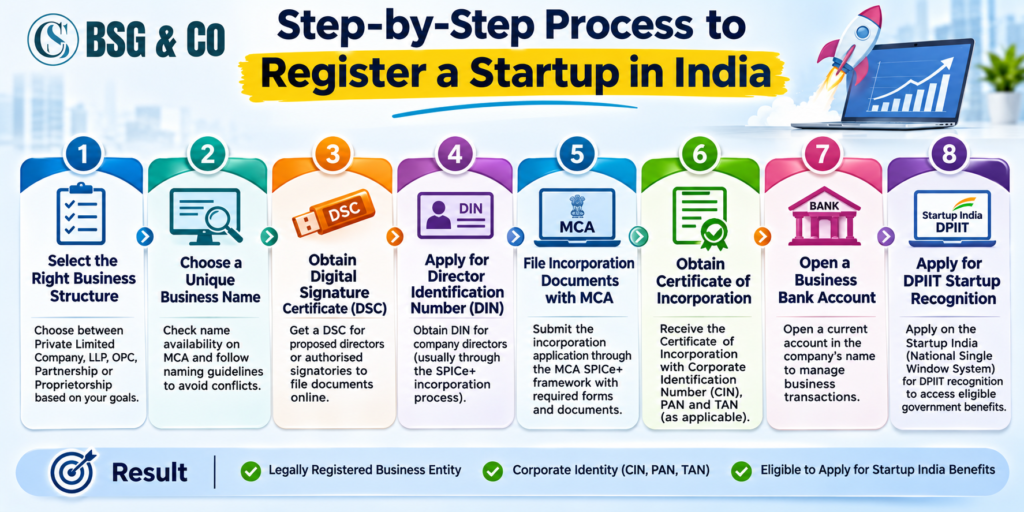
Step 1 – Select the Right Business Structure
Choose between a Private Limited Company, LLP, OPC, partnership or proprietorship.
Consider the number of founders, investment requirements, liability protection, ownership arrangements and future expansion plans.
For example, a business planning to raise equity funding may benefit from a Private Limited Company, while a professional consultancy may prefer an LLP.
Step 2 – Choose a Unique Business Name
Select a professional name that represents your business activities.
Check the MCA database for existing company names and search the trademark database to identify potential conflicts.
The proposed name must follow applicable MCA naming guidelines. Company name approval does not automatically provide trademark protection.
Step 3 – Obtain Digital Signature Certificates
A DSC is an electronic signature used to authenticate documents submitted through government portals.
Proposed directors, designated partners or authorised signatories may require DSCs to complete electronic incorporation filings.
Step 4 – Apply for Director Identification Number
DIN is a unique identification number allotted to an individual who becomes a company director.
For eligible new company incorporations, DIN can generally be applied for through the SPICe+ incorporation process, subject to prescribed conditions.
Step 5 – File Incorporation Documents with MCA
Company incorporation is completed through the Ministry of Corporate Affairs portal.
The SPICe+ framework includes:
- SPICe+ Part A for name reservation.
- SPICe+ Part B for incorporation.
- e-MOA (INC-33), where applicable.
- e-AOA (INC-34), where applicable.
- AGILE-PRO-S (INC-35).
- Other applicable declarations and linked forms.
LLP incorporation follows its separate MCA filing procedure.
Step 6 – Obtain the Certificate of Incorporation
After successful verification, the Registrar of Companies issues the Certificate of Incorporation.
The certificate contains the Corporate Identification Number (CIN). PAN and TAN are also allotted through the integrated process, subject to applicable requirements.
Step 7 – Open a Business Bank Account
Open a current account in the registered business name.
A separate account helps maintain financial transparency, receive customer payments, manage expenses and maintain proper accounting records.
Companies must also complete applicable share subscription and commencement-of-business formalities, including filing Form INC-20A where required.
Step 8 – Apply for DPIIT Startup Recognition
After incorporation, eligible businesses can apply through the National Single Window System (NSWS).
The general application process includes:
- Create an account on the NSWS portal.
- Access the applicant dashboard.
- Select Add Approvals.
- Choose the applicable Startup Registration approval.
- Enter the required business information.
- Upload supporting documents.
- Submit the application for verification.
DPIIT recognition is a separate procedure and is not automatically granted after incorporation.
What Is Startup India Registration and DPIIT Recognition?
Startup India is a government initiative designed to encourage innovation, entrepreneurship and business development.
DPIIT recognition provides eligible businesses with access to specified startup-related benefits and government initiatives.
Some potential benefits include:
- Access to eligible government startup schemes.
- Intellectual property facilitation benefits.
- Certain self-certification benefits.
- Relaxations in eligible government procurement conditions.
- Opportunities to participate in incubation and funding programmes.
- Eligibility to apply for specified tax benefits.
For example, Section 80-IAC provides eligible startups with a deduction of 100% of qualifying business profits for three consecutive assessment years within the prescribed ten-year period.
However, DPIIT recognition alone does not automatically provide this tax exemption. Separate eligibility requirements and certification apply.
Benefits of Registering a Startup in India
There are several advantages to completing proper business incorporation.
- Legal identity: Companies and LLPs have identities separate from their owners.
- Limited liability: Suitable structures protect personal assets, subject to applicable law.
- Business credibility: Registration improves professional recognition.
- Investment opportunities: Companies can offer shares to eligible investors.
- Government support: Eligible businesses can explore startup schemes.
- Business expansion: A formal structure supports long-term growth.
- Ownership clarity: Founder responsibilities and shareholding can be documented.
- Tax opportunities: Eligible businesses can apply for applicable tax benefits.
- Market opportunities: Registered businesses can participate in eligible institutional opportunities.
How Much Does It Cost to Register a Startup in India?
The cost depends on the selected legal structure, authorised capital, state-specific stamp duty and professional assistance.
Common expenses include:
| Cost component | Description |
| Government filing fees | Applicable MCA incorporation charges |
| DSC charges | Digital signature expenses |
| Stamp duty | Depends on state and documents |
| Name reservation | Applicable reservation charges |
| Professional fees | Company Secretary or other professional charges |
| Additional registrations | GST and other applicable licences |
There is no single fixed price for every business. Entrepreneurs should obtain a cost estimate based on their incorporation requirements.
Registrations and Licences Required After Startup Incorporation
Depending on business activities, additional registrations may be necessary.
- GST Registration: For businesses meeting applicable thresholds or compulsory registration conditions.
- Udyam Registration: For eligible MSMEs.
- Shops and Establishments Registration: Where applicable under Karnataka law.
- Professional Tax: Applicable employer and enrolment requirements.
- EPFO and ESIC: Depending on employee strength and applicable provisions.
- Import Export Code: For eligible import and export activities.
- FSSAI Registration: For applicable food businesses.
- Trademark Registration: To protect the brand name and logo.
- Industry-specific licences: Based on the business sector.
Not every startup requires every registration.
Common Mistakes to Avoid When Registering a Startup
Founders should avoid these common mistakes:
- Selecting an unsuitable legal structure.
- Choosing a name similar to an existing trademark.
- Submitting incorrect incorporation documents.
- Not planning founder shareholding properly.
- Ignoring shareholders’ agreements.
- Failing to maintain accounting records.
- Missing annual statutory filing deadlines.
- Assuming DPIIT recognition is automatic.
- Ignoring intellectual property protection.
Professional guidance can help prevent compliance issues and unnecessary expenses.
Why Choose BSG & CO for Startup Registration in Bangalore?
BSG & CO is a professional Company Secretary firm in Bangalore offering corporate secretarial and business registration assistance to entrepreneurs and business owners.
Professional support is valuable when selecting the right business structure, preparing documents and understanding statutory obligations.
BSG & CO can assist with:
- Private Limited Company registration.
- LLP registration in India.
- Business structure selection.
- MCA incorporation documentation and filing coordination.
- DPIIT Startup Recognition assistance.
- Corporate compliance guidance.
- Annual statutory filing assistance.
- Founder shareholding documentation.
- Trademark-related professional assistance.
Whether you are a first-time entrepreneur, freelancer or established business owner, professional guidance can make the incorporation journey more organised.
If you are planning to register a startup in India, consult BSG & CO for assistance with applicable registration procedures and corporate compliance.
Frequently Asked Questions About Startup Registration in India
-
How can I register a startup in India?
Select a business structure, prepare the required documents, obtain DSCs where applicable and submit the incorporation application through the relevant MCA process. Eligible businesses can subsequently apply for DPIIT recognition.
-
Can I register a startup without an office?
Yes. A commercial office is not compulsory in every case. However, companies and LLPs generally require a valid registered office address with appropriate supporting documents.
-
What is the minimum investment required to start a company in India?
There is no general minimum paid-up capital requirement for incorporating a Private Limited Company under the current Companies Act framework. However, founders should arrange sufficient operating funds.
-
Is a Private Limited Company better than an LLP?
A Private Limited Company is generally suitable for businesses planning equity investment and expansion. An LLP may be preferable for professional and service-based businesses.
-
How long does startup registration take in India?
The timeline depends on documentation, name availability, government processing and possible resubmissions. No fixed approval timeline can be guaranteed.
-
Is Startup India registration mandatory?
No. DPIIT recognition is optional. Eligible startups can apply to access specified government benefits.
-
What is the difference between company incorporation and DPIIT recognition?
Incorporation legally establishes a company or LLP. DPIIT recognition identifies an eligible entity as a startup under the Startup India framework.
-
Can an individual register a startup in India?
Yes. An individual can establish a proprietorship or an eligible OPC. However, these structures are not eligible under the general DPIIT recognition framework.
-
What documents are required for startup registration?
Common documents include PAN, identity proof, address proof, registered office documents, DSCs where applicable and details of directors or partners. Companies also require MOA and AOA.
-
Can a newly registered company apply for DPIIT recognition?
Yes. A newly incorporated Private Limited Company can apply if it satisfies the applicable age, turnover, innovation and other DPIIT eligibility conditions.
Conclusion – Start Your Entrepreneurial Journey with the Right Registration
Building a successful business begins with a strong legal foundation. Selecting the appropriate business structure, preparing incorporation documents, completing MCA formalities and understanding statutory responsibilities are important steps for every entrepreneur.
Knowing how to register a startup in India helps founders avoid common mistakes and establish a business that is prepared for future opportunities.
Whether you are planning a technology company, consulting firm, e-commerce business or innovative service, ensure that your incorporation and compliance requirements are properly addressed.
Planning to start your business in Bangalore?
Connect with BSG & CO, Company Secretary Firm in Bangalore, for professional assistance with company incorporation, LLP registration, DPIIT Startup Recognition and corporate compliance.
Take your first step towards building a legally structured and growth-ready business with the right professional guidance.
Contact BSG & Co
Phone: +91-8660360492
Email: bhaskar@bhaskarbhatandco.in
Website: www.csfirmbsg.com
Address: 2nd Floor, 66, 13th Main Rd, 4th T Block East, 4th Block, Jayanagar, Bengaluru, Karnataka 560011
Official references for editorial verification: