
Company Registration in India: A Complete Guide for Entrepreneurs
Starting a business in India involves more than having a good idea and finding customers. Choosing the right legal structure can influence ownership, liability, taxation, funding opportunities, compliance responsibilities, and long-term growth. For entrepreneurs who want a formal corporate structure, company registration provides a recognised framework for operating a business under Indian company law.
In India, incorporation is administered through the Ministry of Corporate Affairs (MCA) and the relevant Registrar of Companies (ROC). The process is largely electronic and requires founders to provide prescribed information and supporting documents.
This guide explains the key aspects of incorporating a company, from choosing the structure and preparing documents to completing post-incorporation compliance.
What Is Company Registration?
At its core, company registration is the legal process through which a business entity is incorporated under the Companies Act and recognised as a company.
An incorporated company generally has a legal identity separate from its members. This means the company can own assets, enter into contracts, incur liabilities, and conduct business in its own name.
The MCA oversees corporate affairs and maintains the central regulatory framework, while the ROC handles incorporation and statutory filings for companies within its jurisdiction.

Once incorporation is approved, the company receives a Certificate of Incorporation containing important information such as:
- Legal name of the company
- Date of incorporation
- Corporate Identity Number (CIN)
- Registrar jurisdiction
The distinction between an informal business and an incorporated company is significant. A sole proprietorship, for example, does not create a separate legal person from its owner. An incorporated company, subject to the applicable law and structure, operates as a distinct legal entity.
For businesses planning long-term operations, multiple owners, external investment, or significant commercial contracts, company registration can provide a formal foundation for growth.
Why Should You Register a Company in India?
Entrepreneurs consider incorporation for several business and legal reasons. The advantages depend on the structure selected and the company’s circumstances.
Key benefits may include:
Separate Legal Identity
A company generally exists independently of its shareholders. This can make it easier to separate business assets, contracts, and obligations from the personal affairs of owners.
Limited Liability
In structures such as a Private Limited Company, shareholders’ liability is generally limited according to the applicable legal framework and their agreed contribution. However, limited liability does not protect against every form of personal liability.
Business Credibility
A formally incorporated entity can provide a more structured identity when dealing with customers, vendors, banks, employees, and other businesses.
Investment and Ownership Structure
Companies can issue and transfer shares according to applicable laws, making a corporate structure useful for businesses planning to introduce investors or restructure ownership.
Business Continuity
A company can continue independently of changes in individual shareholders or directors, subject to applicable legal requirements.
Expansion
A corporate structure may be suitable for businesses intending to expand into new markets, employ larger teams, enter commercial agreements, or establish more formal financial systems.
However, incorporation does not guarantee funding, profitability, investment, tax benefits, or commercial success. Entrepreneurs should select a structure based on their actual business requirements.
Types of Companies You Can Register in India
Different structures serve different purposes. The following are among the important options available to entrepreneurs.
Private Limited Company
A Private Limited Company is commonly considered by startups and businesses seeking a share-based ownership structure.
It generally requires at least two members and two directors, subject to the applicable provisions. A private company can provide limited liability and a structured mechanism for holding shares.
It may be appropriate for businesses that expect to raise investment, have multiple founders, establish employee ownership arrangements, or pursue significant growth.
The trade-off is greater compliance compared with simpler business structures.
One Person Company
An One Person Company (OPC) provides a corporate structure for a single member, subject to eligibility and applicable legal requirements.
It offers separate legal identity while allowing an individual entrepreneur to operate through a company structure. Compliance requirements and conversion rules should be understood before selecting this option.
Public Limited Company
A Public Limited Company has a broader ownership framework and is subject to more extensive regulatory and disclosure requirements.
This structure may be appropriate for businesses requiring wider capital participation or pursuing a scale where a public-company framework is relevant. It generally involves substantially more compliance than a private company.
Section 8 Company
A Section 8 Company is formed for permitted objectives such as charitable, educational, social, environmental, or other not-for-profit purposes.
Its profits are generally applied towards its objectives rather than distributed to members as ordinary dividends, subject to applicable law.
The most suitable structure depends on the founders, objectives, funding plans, risk profile, and nature of operations.
Basic Requirements for Company Registration
Before starting the company registration process, founders should understand the basic requirements applicable to their proposed entity.
Common requirements include:
- Selection of an appropriate company structure
- Minimum required directors and members
- Registered office in India
- Director identification requirements
- Digital signatures for applicable filings
- Proposed company name
- Memorandum of Association (MOA)
- Articles of Association (AOA)
- Identity and address documentation
- Share capital and ownership details
Requirements may differ depending on the company type, founder profile, foreign participation, proposed business activity, and sector-specific regulations.
Digital Signature Certificate
A Digital Signature Certificate (DSC) is used for signing electronic documents and filings submitted through the MCA system. Directors and other authorised individuals may require digital signatures depending on the filing.
Director Identification Number
A Director Identification Number (DIN) is a unique identification number associated with an individual who acts or proposes to act as a director, subject to the applicable process.
Documents Required for Company Registration
Preparing accurate documents is one of the most important parts of incorporation. Inconsistent names, addresses, dates, or identification information can create avoidable delays.
Documents for Directors and Shareholders
Commonly required documents may include:
- PAN card
- Aadhaar card or another accepted identity document
- Passport, where applicable
- Address proof
- Recent photograph
- Email address
- Mobile number
- Digital Signature Certificate, where required
The exact documents can depend on whether the person is an Indian resident, foreign national, individual, or corporate shareholder.
Documents for Registered Office
Typical registered-office documentation can include:
- Ownership proof or rental/lease agreement
- Recent utility bill
- No Objection Certificate, where applicable
- Other supporting address documents when required
Foreign nationals and foreign entities may need additional documentation, including notarisation, apostille, consularisation, or other authentication depending on the country and applicable requirements.
Step-by-Step Company Registration Process in India
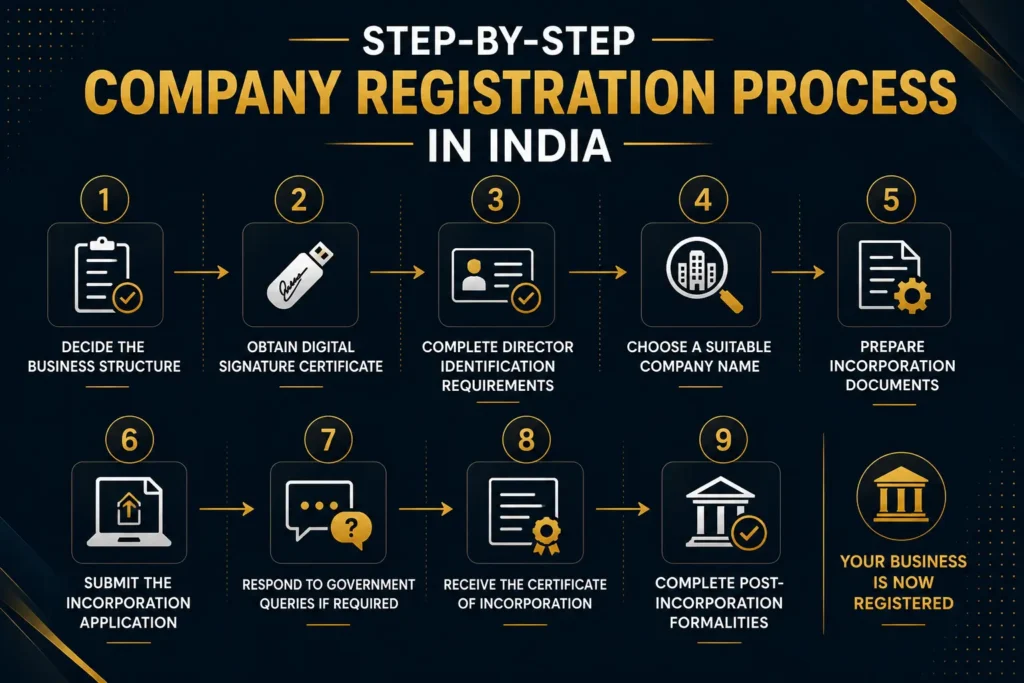
The company registration process generally involves several stages. The exact forms and sequence may vary according to the company and circumstances.
Step 1: Decide the Business Structure
First, determine whether a Private Limited Company, OPC, Section 8 Company, or another structure is appropriate.
Consider the number of owners, liability, funding plans, expected turnover, compliance requirements, and long-term objectives.
Step 2: Obtain Digital Signature Certificate
Applicable individuals obtain DSCs so that electronic documents can be digitally signed and submitted through the MCA system.
Step 3: Complete Director Identification Requirements
The proposed directors must satisfy the applicable identification requirements. DIN may be obtained or handled through the prescribed incorporation process, depending on the circumstances.
Step 4: Choose a Suitable Company Name
The proposed name should be checked carefully before filing.
Consider:
- Availability and uniqueness
- MCA naming rules
- Existing company names
- Trademark conflicts
- Business relevance
- Restricted or prohibited expressions
- Potential confusion with established brands
Checking relevant trademarks before finalising a name can help reduce the risk of future disputes.
Step 5: Prepare Incorporation Documents
The incorporation documentation generally covers the company’s constitution, ownership, directors, registered office, capital, and proposed business activities.
The MOA establishes fundamental aspects of the company, while the AOA contains rules governing its internal management.
Step 6: Submit the Incorporation Application
The incorporation application is submitted electronically through the MCA system using the applicable forms and supporting documents.
The information supplied should be consistent across identity documents, declarations, constitutional documents, and address proofs.
Step 7: Respond to Government Queries if Required
The ROC may request clarification, corrections, or additional information where necessary.
If a query is received, the response should address the specific issue accurately and within the prescribed requirements.
Step 8: Receive the Certificate of Incorporation
Once the incorporation process is successfully completed, the company receives its Certificate of Incorporation.
The certificate confirms incorporation and contains the company’s CIN and incorporation date.
Step 9: Complete Post-Incorporation Formalities
Incorporation is not the final step. Depending on the circumstances, the company may need to complete requirements relating to:
- PAN and TAN
- Company bank account
- Capital subscription
- Commencement-related declarations
- GST registration, where applicable
- Accounting systems
- Statutory registers
- Auditor appointment
- Other statutory filings
How Long Does Company Registration Take?
There is no universal fixed timeline for company registration. Processing time can vary according to the application and government processing requirements.
Factors that may affect the timeline include:
- Name approval
- Accuracy of documents
- Availability of digital signatures
- Government processing
- Clarifications
- Corrections or resubmissions
- Foreign shareholders or directors
- Sector-specific permissions
Applications containing accurate and consistent information can help reduce avoidable delays, but government processing timelines cannot be guaranteed.
What Is the Cost of Company Registration?
The cost of company registration depends on the proposed structure and circumstances of the business.
Potential expenses can include:
- Government filing fees
- Stamp duty
- Authorised capital-related charges
- State-specific charges
- Digital Signature Certificate costs
- Professional fees
- Additional registrations
- Industry-specific licences
Government fees and regulatory charges can change, so entrepreneurs should verify the applicable amounts at the time of filing.
It is also important to distinguish government charges from professional service fees. The overall cost may differ significantly depending on the number of directors, shareholders, state, capital structure, and additional registrations required.
Company Registration vs Other Business Structures
No single business structure is suitable for every entrepreneur.
| Business Structure | Legal Identity | Liability | Compliance | Investment Potential | Suitable For |
| Private Limited Company | Separate | Generally limited | Higher | High | Startups and growing businesses |
| LLP | Separate | Generally limited | Moderate | Moderate | Partner-led businesses |
| Partnership Firm | Generally not separate in the same manner | Usually broader partner exposure | Lower | Limited | Small businesses |
| Sole Proprietorship | No separate identity | Unlimited | Lower | Limited | Individual small businesses |
The right structure depends on the number of owners, business risk, funding plans, compliance capacity, growth objectives, and nature of operations.
Common Mistakes to Avoid
Entrepreneurs can avoid many incorporation problems by reviewing their information before filing.
Common mistakes include:
- Choosing a name without checking trademark conflicts
- Selecting a structure without understanding its implications
- Submitting incorrect or inconsistent documents
- Using unsuitable registered-office documentation
- Providing outdated address proof
- Describing business activities inaccurately
- Ignoring additional requirements for foreign participation
- Failing to plan shareholding properly
- Assuming incorporation ends all compliance obligations
- Forgetting post-incorporation filings
A careful review of ownership, business objectives, documents, and proposed activities before filing can prevent many avoidable issues.
Post-Registration Compliance Requirements
Completing company registration does not end the company’s legal responsibilities. It begins an ongoing compliance cycle.
Depending on the company and its activities, obligations may include:
- Annual MCA filings
- Financial statements
- Income tax returns
- Statutory audit where applicable
- Board meetings
- Maintenance of statutory registers
- Director-related filings
- Share-related filings
- GST returns, where applicable
- TDS compliance, where applicable
- Event-based MCA filings
- Industry-specific licences and regulations
The actual compliance burden depends on the company’s structure, turnover, activities, transactions, registrations, and available exemptions.
Maintaining proper accounting records and monitoring filing deadlines can help the company remain compliant.
Who Should Consider Company Registration?
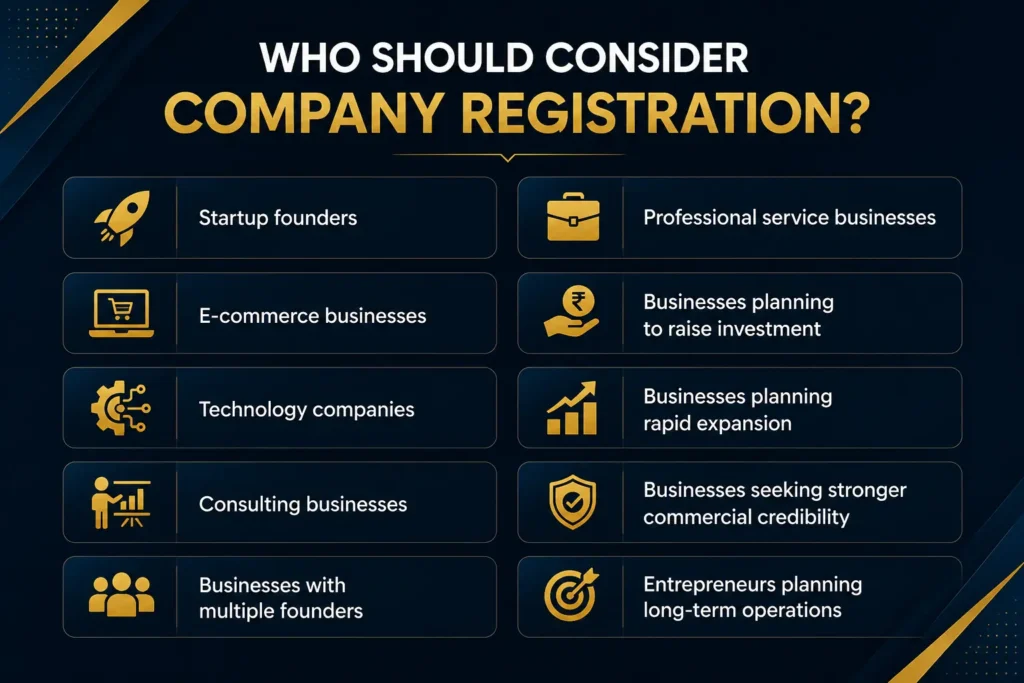
Company registration may be suitable for businesses that want a formal corporate structure and expect to operate for the long term.
It can be considered by:
- Startup founders
- Technology companies
- E-commerce businesses
- Consulting businesses
- Professional service businesses
- Businesses with multiple founders
- Businesses planning to raise investment
- Businesses planning rapid expansion
- Businesses seeking stronger commercial credibility
- Entrepreneurs planning long-term operations
At the same time, incorporation is not automatically necessary for every small business. A simpler structure may be more appropriate where the business has limited risk, a single owner, straightforward operations, or no immediate requirement for external investment.
Can Foreigners Register a Company in India?
Foreign participation in an Indian company is possible subject to applicable corporate, foreign investment, exchange-control, sectoral, and other regulations.
Foreign directors and shareholders may need documents such as:
- Passport
- Overseas address proof
- Notarised documents
- Apostilled or consularised documents, where applicable
- Corporate authorisation documents for foreign entities
Certain sectors may have restrictions, approval requirements, or specific conditions relating to foreign investment.
Foreign participation can also involve FEMA-related considerations and Indian resident director requirements. Because the rules can depend heavily on nationality, ownership, sector, investment route, and transaction structure, such cases require careful regulatory review.
Frequently Asked Questions About Company Registration
- What is company registration in India?
It is the legal incorporation of a company under applicable Indian company law. Once incorporated, the entity receives a Certificate of Incorporation and a Corporate Identity Number.
- How do I register a company in India?
You generally select the business structure, arrange applicable digital signatures and director identification, choose a compliant name, prepare incorporation documents, submit the prescribed MCA application, respond to queries if required, and obtain the Certificate of Incorporation.
- How many directors are required to register a Private Limited Company?
Generally, a Private Limited Company requires at least two directors. Certain director-related statutory conditions and eligibility requirements also apply.
- Can one person register a company in India?
Yes. An eligible individual may consider an One Person Company, which is designed for a single-member corporate structure. It is different from a standard Private Limited Company.
- Is a registered office mandatory?
Yes. A company must have a registered office capable of receiving official communications and notices. Appropriate address documentation may be required.
- What documents are needed for company registration?
Common documents include PAN, identity proof, address proof, photographs, contact details, DSC where required, and registered-office documents. Additional documents may apply to foreign participants.
- What happens after company registration?
The company must complete applicable post-incorporation formalities and maintain ongoing compliance. These may include tax registrations, banking arrangements, accounting records, statutory filings, audit, registers, and event-based filings.
Conclusion
Choosing the appropriate legal structure is an important decision for anyone planning to build a business in India. Company registration can provide a formal corporate identity, structured ownership, and a framework that may support future growth.
Entrepreneurs should carefully evaluate their business model, ownership arrangement, funding plans, liability exposure, compliance capacity, and long-term objectives before incorporation.
Accurate documentation, appropriate name selection, proper understanding of costs and timelines, and attention to post-incorporation responsibilities are equally important. Since government procedures, fees, forms, and regulations can change, information should be verified against the applicable requirements at the time of filing.
For straightforward cases, the process can be managed systematically. Where foreign participation, regulated activities, complex ownership, or other special circumstances are involved, professional guidance may be useful.
BSG & Co provides professional assistance for entrepreneurs and businesses seeking guidance on company registration and related corporate compliance requirements.
Phone: +91-8660360492
Email: bhaskar@bhaskarbhatandco.in
Website: www.csfirmbsg.com
Address: 2nd Floor, 66, 13th Main Rd, 4th T Block East, 4th Block, Jayanagar, Bengaluru, Karnataka 560011
Entrepreneurs can contact the firm to discuss their business requirements and understand the applicable incorporation and compliance considerations.