
Fund Raising for Startup: A Complete Guide to Raising Capital in India
Starting and growing a business often requires more than a good idea. Founders may need capital to develop products, hire employees, build technology, acquire customers, purchase inventory, manage working capital, expand into new markets, or scale operations. This is where fund raising for startup becomes an important part of the growth strategy.
However, raising capital is not simply about finding an investor and asking for money. A successful fundraising process usually requires financial planning, investor readiness, realistic valuation, strong documentation, clear business objectives, and careful negotiation.
In India, founders can explore several sources of capital, including personal savings, angel investors, venture capital, loans, incubators, accelerators, strategic investors, and government-supported initiatives. The right option depends on the startup’s stage, business model, cash flow, growth plans, risk profile, and long-term objectives.
This guide explains the fundamentals of fund raising for startup, from deciding how much to raise to preparing a pitch deck, understanding valuation, completing due diligence, and reviewing investment terms.
What Is Fund Raising for a Startup?
Fund raising for startup refers to the process through which a startup obtains capital to support business activities and growth. The capital may come from founders, private investors, institutional investors, lenders, government-supported programmes, or other permitted sources.
A startup may raise money through equity funding, where investors receive an ownership interest, or through debt funding, where the business generally has a repayment obligation.
The purpose of fundraising should be clearly defined. For example, a founder may require capital to:
- Build a minimum viable product
- Hire a technical or sales team
- Purchase inventory
- Launch marketing campaigns
- Improve technology infrastructure
- Expand geographically
- Strengthen working capital
- Reach specific growth milestones
External capital should ideally solve a defined business need rather than simply increase the company’s bank balance.
Why Do Startups Raise Funds?
The reasons for fund raising for startup vary considerably according to the business stage.
Product Development
Early-stage businesses may need capital for research, prototype development, testing, software development, product improvement, or commercialisation.
Hiring
Capital can support recruitment across technology, sales, marketing, finance, operations, customer support, and leadership functions.
Marketing and Customer Acquisition
Businesses may need funding to test acquisition channels and build brand awareness. However, founders should monitor customer acquisition costs, retention, contribution margins, and other unit economics rather than assuming that more marketing automatically creates sustainable growth.
Working Capital
A growing business can face a gap between paying suppliers and receiving customer payments. Adequate working capital can help manage salaries, inventory, rent, technology, and other operating expenses.
Expansion
Capital may support entry into new cities, customer segments, product categories, or international markets.
Technology and Infrastructure
Technology businesses may require significant spending on cloud infrastructure, cybersecurity, software, equipment, data systems, and product engineering.
Different Stages of Startup Funding
The capital requirement generally changes as a business develops. Fund raising for startup should therefore be aligned with the company’s actual stage rather than based only on how much money is available in the market.
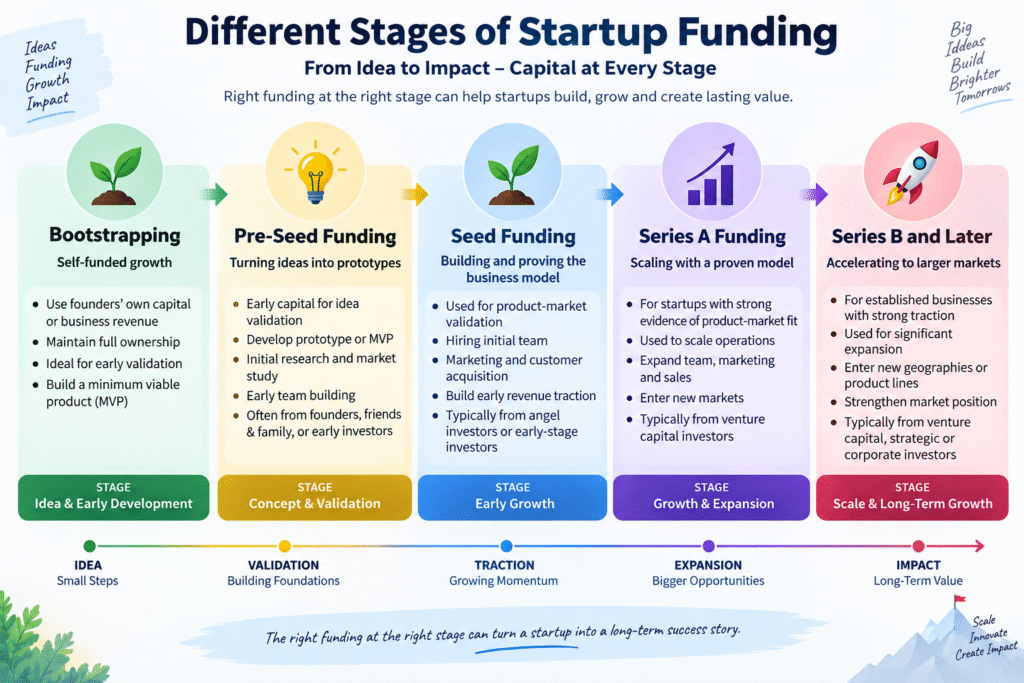
Bootstrapping
Bootstrapping means financing the business through founders’ capital and revenue generated by the business.
Advantages:
- Greater founder control
- No immediate equity dilution
- Encourages disciplined spending
Limitations:
- Growth may be slower
- Founders carry more financial risk
- Available capital may be limited
Pre-Seed Funding
Pre-seed capital is generally used during the early stages for:
- Idea validation
- Market research
- Prototype development
- Initial hiring
- Early product testing
Seed Funding
Seed funding may support product-market validation, customer acquisition, hiring, marketing, and early growth.
Series A Funding
Series A generally involves businesses that have stronger evidence of market demand and are preparing to scale their operations.
Series B and Later Funding
Later rounds may provide growth capital for larger expansion, new markets, acquisitions, infrastructure, or international operations.
Not every startup follows this sequence. Some businesses remain bootstrapped, while others use debt, strategic capital, grants, or alternative financing structures.
Sources of Startup Funding in India
There are several potential sources of fund raising for startup in India.
| Funding Source | Potential Benefit | Important Consideration |
| Founders’ capital | Maximum control | Limited personal capital |
| Friends and family | Early support | Personal relationships can be affected |
| Angel investors | Capital plus experience | Equity dilution may occur |
| Venture capital | Larger growth capital | Strong growth expectations |
| Strategic investors | Capital plus industry access | Strategic rights may be involved |
| Bank loans | No normal equity dilution | Repayment and eligibility requirements |
| NBFC financing | Alternative debt option | Cost and repayment obligations |
| Incubators/accelerators | Mentorship and ecosystem access | Selection criteria vary |
| Government schemes | Potential structured support | Eligibility and rules vary |
| Crowdfunding | Alternative capital route | Must comply with applicable laws |
Founders should evaluate the cost, control implications, repayment obligations, investor expectations, and suitability of each source before proceeding.
Equity Funding vs Debt Funding
Understanding the difference between equity and debt is essential when planning fund raising for startup.
| Feature | Equity Funding | Debt Funding |
| Ownership | Shares may be issued | No ownership normally transferred |
| Repayment | Usually no fixed loan repayment | Principal and interest generally payable |
| Dilution | Possible | Generally no equity dilution |
| Investor/Lender Risk | Higher | Structured repayment obligation |
| Suitable For | High-growth startups | Businesses with repayment capacity |
The right choice depends on cash flow, business risk, funding requirements, expected growth, existing ownership, and the founders’ long-term plans.
How Much Funding Should a Startup Raise?
One of the most important parts of fund raising for startup is determining the amount to raise.
Founders should avoid selecting an arbitrary number. Instead, prepare a financial plan covering:
- Current monthly operating expenses
- Product development costs
- Hiring requirements
- Marketing expenditure
- Working capital
- Technology expenses
- Expansion plans
- Contingency requirements
- Expected business milestones
A useful concept is runway. Runway represents how long the available cash can support the business at its current or planned spending level.
For example, if a startup has ₹60 lakh available and expects average monthly cash expenditure of ₹10 lakh, its simple cash runway would be approximately six months, before considering changes in revenue or spending.
The objective should be to raise enough capital to reach the next meaningful milestone, while avoiding unnecessary dilution or excessive debt.
How to Prepare Your Startup Before Fundraising
Investor readiness can significantly improve the quality of fundraising discussions. Before approaching investors, founders should organise the business and supporting information.
Strong Business Model
Be clear about:
- Who the customers are
- What problem is being solved
- How the company makes money
- Pricing
- Gross margins
- Customer acquisition
- Retention
- Scalability
Clear Financial Records
Maintain reliable records covering:
- Revenue
- Expenses
- Cash flow
- Profit and loss
- Balance sheet
- Financial projections
- Tax and statutory records
Financial projections should be realistic and supported by understandable assumptions.
Cap Table
A cap table, or capitalisation table, records ownership of the company. It should clearly reflect founders, existing investors, employee equity and other relevant securities.
An inaccurate cap table can create significant problems during due diligence.
Legal Structure
Investors may examine incorporation records, shareholder agreements, intellectual property ownership, contracts and statutory compliance.
Founders should ensure that the company’s records are organised before beginning serious negotiations.
Intellectual Property
Depending on the business, review trademarks, copyrights, patents, software ownership, domain names, licences and employee or contractor IP arrangements.
How to Create an Investor-Ready Pitch Deck
A strong pitch deck should communicate the business clearly rather than overwhelm investors with information.
A typical investor pitch can include:
- Problem
- Solution
- Product
- Market opportunity
- Business model
- Traction
- Competition
- Competitive advantage
- Marketing and growth strategy
- Team
- Financial projections
- Funding requirement
- Use of funds
- Future milestones
The deck should be concise, evidence-based and consistent with the financial information provided elsewhere.
During fund raising for startup, investors may challenge assumptions. Founders should therefore understand every important number in the presentation.
How to Approach Investors
A practical fundraising strategy begins with identifying investors whose interests match the startup.
Consider these steps:
- Research investors and their investment focus.
- Understand the stage and sectors they typically consider.
- Prepare a short and clear introduction.
- Build relevant professional relationships.
- Explore incubators and accelerators.
- Attend appropriate startup events.
- Seek credible introductions where available.
- Personalise investor communication.
- Follow up professionally.
- Maintain an organised fundraising pipeline.
Approaching every investor with the same generic message is usually less effective than demonstrating why the business may fit the investor’s focus.
Understanding Startup Valuation
Startup valuation is an estimate of what a business is worth for a particular transaction. Early-stage valuation can involve considerable uncertainty because the company may have limited revenue, operating history, or predictable cash flows.
Factors that may influence valuation include:
- Revenue
- Growth rate
- Market size
- Customer base
- Traction
- Business model
- Intellectual property
- Competitive position
- Team
- Future growth potential
- Comparable businesses
Pre-Money and Post-Money Valuation
Pre-money valuation refers to the company’s agreed valuation before a new investment.
Post-money valuation generally refers to the valuation after the investment is included.
For example, suppose a startup has a pre-money valuation of ₹4 crore and receives ₹1 crore of new equity investment. A simplified post-money valuation would be ₹5 crore. The new investor’s ownership would be approximately 20%, subject to the actual transaction structure and securities issued.
Valuation is negotiated and depends on the circumstances of the business and transaction. It should not be treated as a guaranteed market price.
Equity Dilution: What Founders Should Know
Equity dilution occurs when new shares or other equity interests are issued and the percentage ownership of existing shareholders decreases.
For example, if founders collectively own 100% before an investment and new shares representing 20% of the company after investment are issued, the original shareholders collectively own approximately 80% afterward.
Dilution is not automatically negative. If new capital helps a business increase its overall value substantially, owning a smaller percentage of a much larger company may still benefit the founders.
However, founders should understand current and potential future dilution, employee option pools, convertible instruments, and subsequent investment rounds before accepting capital.
What Happens During Investor Due Diligence?
Due diligence is the process of reviewing a startup before an investment is completed.
Investors may examine:
- Incorporation documents
- Shareholding records
- Financial statements
- Bank records
- Tax compliance
- Customer and supplier contracts
- Intellectual property
- Employee agreements
- Existing loans
- Litigation or disputes
- Licences and regulatory approvals
- Previous investment agreements
Good preparation can make this process more efficient.
Understanding a Term Sheet
A term sheet generally summarises key commercial terms proposed for an investment.

Common terms may include:
- Investment amount
- Valuation
- Equity percentage
- Liquidation preference
- Board rights
- Voting rights
- Information rights
- Founder restrictions
- Exit provisions
- Conditions precedent
A term sheet may be non-binding in whole or in part depending on its wording. Some provisions can be expressly binding.
Founders should not rely only on verbal explanations. Important investment documents should be reviewed by appropriately qualified legal professionals before signing.
Common Fundraising Mistakes Startups Should Avoid
Many challenges in fund raising for startup can be reduced through better preparation.
Avoid:
- Raising money without a defined purpose
- Overestimating valuation
- Approaching unsuitable investors
- Maintaining incomplete financial records
- Ignoring statutory compliance
- Creating unrealistic financial projections
- Failing to understand dilution
- Accepting unsuitable investment terms
- Neglecting investor due diligence
- Spending capital without measurable objectives
- Starting fundraising only when cash is almost exhausted
A disciplined fundraising process should begin before the business reaches a financial emergency.
How Long Does Startup Fundraising Take?
There is no universal timeline for fund raising for startup.
The duration can depend on:
- Startup stage
- Investor interest
- Market conditions
- Business traction
- Funding amount
- Valuation expectations
- Due diligence
- Documentation
- Negotiations
- Regulatory requirements
Founders should maintain sufficient runway while fundraising. Depending on a funding round to close immediately can create unnecessary pressure and weaken negotiating flexibility.
Legal and Compliance Considerations
Fundraising can involve significant legal, tax and regulatory obligations.
Depending on the transaction, founders may need to consider:
- Companies Act requirements
- Share issuance procedures
- Private placement requirements where applicable
- Shareholder approvals
- Valuation requirements
- Securities regulations
- FEMA requirements for foreign investors
- Tax implications
- Investment agreements
- Share certificates
- Statutory records
- Regulatory filings and reporting
The exact requirements depend on the company’s structure, investor type, transaction structure and applicable laws.
Because regulations and tax treatment can change, founders should obtain professional legal, tax, accounting or financial advice for specific transactions rather than relying on a general article.
Government Support and Startup Funding Schemes
Government-supported initiatives can be another area for fund raising for startup research.
The Startup India ecosystem currently highlights funding-related initiatives including the Startup India Seed Fund Scheme, Fund of Funds and Investor Connect, along with other support mechanisms. The Seed Fund Scheme is designed to support eligible startups in areas such as proof of concept, prototype development, product trials, market entry and commercialisation.
Other potential avenues include:
- Incubation support
- Credit support
- State-level startup programmes
- Innovation initiatives
- Government-backed funding programmes
Eligibility criteria, application procedures, benefits, available programmes and scheme rules can change. Founders should verify current requirements through official government sources before making financial decisions.
Who Should Consider Fund Raising for a Startup?
Fund raising for startup may be relevant for businesses that have a clear reason to deploy external capital.
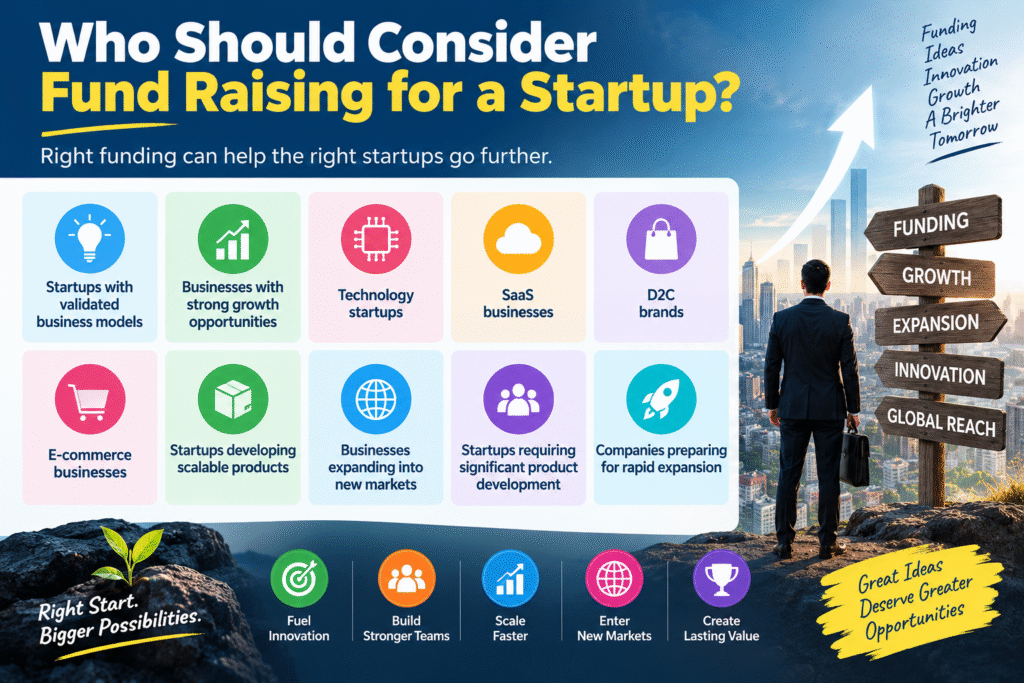
This can include:
- Startups with validated business models
- Technology startups
- SaaS businesses
- D2C brands
- E-commerce businesses
- Scalable product companies
- Businesses entering new markets
- Startups requiring significant product development
- Companies preparing for rapid expansion
However, external funding is not compulsory.
Some businesses may be better suited to bootstrapping and growing through customer revenue. If a company can grow sustainably without giving up equity or taking on debt, founders may reasonably consider that route.
Frequently Asked Questions About Startup Fundraising
-
What is fund raising for startup?
It is the process of obtaining capital for a startup from sources such as founders, investors, lenders, incubators or eligible government-supported programmes.
-
How can I raise funds for my startup in India?
Start by determining the capital requirement, preparing financial projections, organising legal records, building an investor-ready pitch deck and identifying suitable equity, debt or other permitted funding sources.
-
How much funding should a startup raise?
The amount should be based on operating requirements, expected runway, planned milestones, working capital and the capital needed to reach the next meaningful stage of growth.
-
What documents do investors need?
Common documents include incorporation records, cap table, financial statements, bank information, tax records, contracts, intellectual property documents, employee agreements and previous investment documents.
-
What is startup valuation?
Startup valuation is an estimate of a company’s value for a particular transaction. It can depend on revenue, growth, traction, market opportunity, business model, team and other factors.
-
Does raising funds mean giving away equity?
Not always. Equity investment normally involves ownership dilution, while debt generally involves repayment rather than transferring ownership. Other instruments can have different characteristics.
-
How long does startup fundraising take?
There is no fixed timeline. The process depends on investor interest, startup stage, funding requirements, due diligence, negotiations, documentation and applicable regulatory requirements.
-
What is a pitch deck?
A pitch deck is a concise presentation explaining the startup’s problem, solution, market, business model, traction, team, financial projections, funding requirement and planned use of capital.
Conclusion
Effective fund raising for startup is a strategic business process rather than simply a search for money. Founders should first understand why capital is required, how much is needed and what milestone the funding should help achieve.
The next step is selecting an appropriate funding source and preparing the business for investor or lender review. Strong financial records, a clear business model, an accurate cap table, organised legal documentation and realistic projections can improve fundraising readiness.
Founders should also understand valuation, equity dilution, debt obligations, term-sheet provisions and due-diligence requirements before accepting capital.
Most importantly, funding should support a clear business strategy. Raising money does not guarantee growth, profitability or success. The outcome depends on the startup’s execution, market, financial position, investor interest, terms, compliance and many other factors.
A thoughtful fund raising for startup strategy therefore focuses not only on obtaining capital but also on obtaining the right type and amount of capital at appropriate terms.
BSG & Co
Phone: +91-8660360492
Email: bhaskar@bhaskarbhatandco.in
Website: www.csfirmbsg.com
Address: 2nd Floor, 66, 13th Main Rd, 4th T Block East, 4th Block, Jayanagar, Bengaluru, Karnataka 560011