
Pvt Limited vs LLP: Complete Guide to Choosing the Right Business Structure
Choosing a legal structure is one of the earliest decisions an entrepreneur makes in India. It affects ownership, control, liability, taxation, compliance, fundraising and future growth. Two popular options are a Private Limited Company and a Limited Liability Partnership (LLP).
For many founders, the pvt limited vs llp decision becomes important when a business moves beyond an informal arrangement. Both structures can provide a separate legal identity and limited liability under applicable law, but they differ significantly in ownership, management, compliance and investment.
The right choice depends on the business model, number of founders, investment plans, compliance capacity and long-term objectives. This guide provides a practical comparison without suggesting that one structure is universally better.
What Is a Private Limited Company?
In the pvt limited vs llp comparison, a Private Limited Company is incorporated under the Companies Act, 2013 and has a legal identity separate from its members. Ownership is represented through shares, while management is generally handled by directors under the company’s constitutional documents and applicable law.
A company is commonly considered where founders want structured ownership and may seek external equity investment.
Key features include:
- Separate legal entity
- Shareholders as owners
- Directors responsible for management
- Ownership through shares
- Limited liability, subject to legal exceptions
- MCA and ROC incorporation and filing framework
- Formal corporate governance
What Is an LLP?
In a pvt limited vs llp comparison, a Limited Liability Partnership is a separate legal entity registered under the Limited Liability Partnership Act, 2008. It combines partnership-style management with limited liability and separate legal identity.
An LLP has partners rather than shareholders. Designated partners have specific statutory responsibilities, while the LLP Agreement can set out capital contribution, profit sharing, management rights and other internal arrangements.
Key features include:
- Separate legal entity
- Partners as owners
- Designated partners
- Flexible internal management
- Contract-based profit sharing
- Limited liability subject to applicable law
- MCA registration and continuing compliance
An LLP can be practical for professional practices, consulting businesses, agencies and other partner-led ventures where flexibility is more important than conventional equity fundraising.
Pvt Limited vs LLP: Key Differences
The pvt limited vs llp comparison becomes clearer when the main features are viewed together.
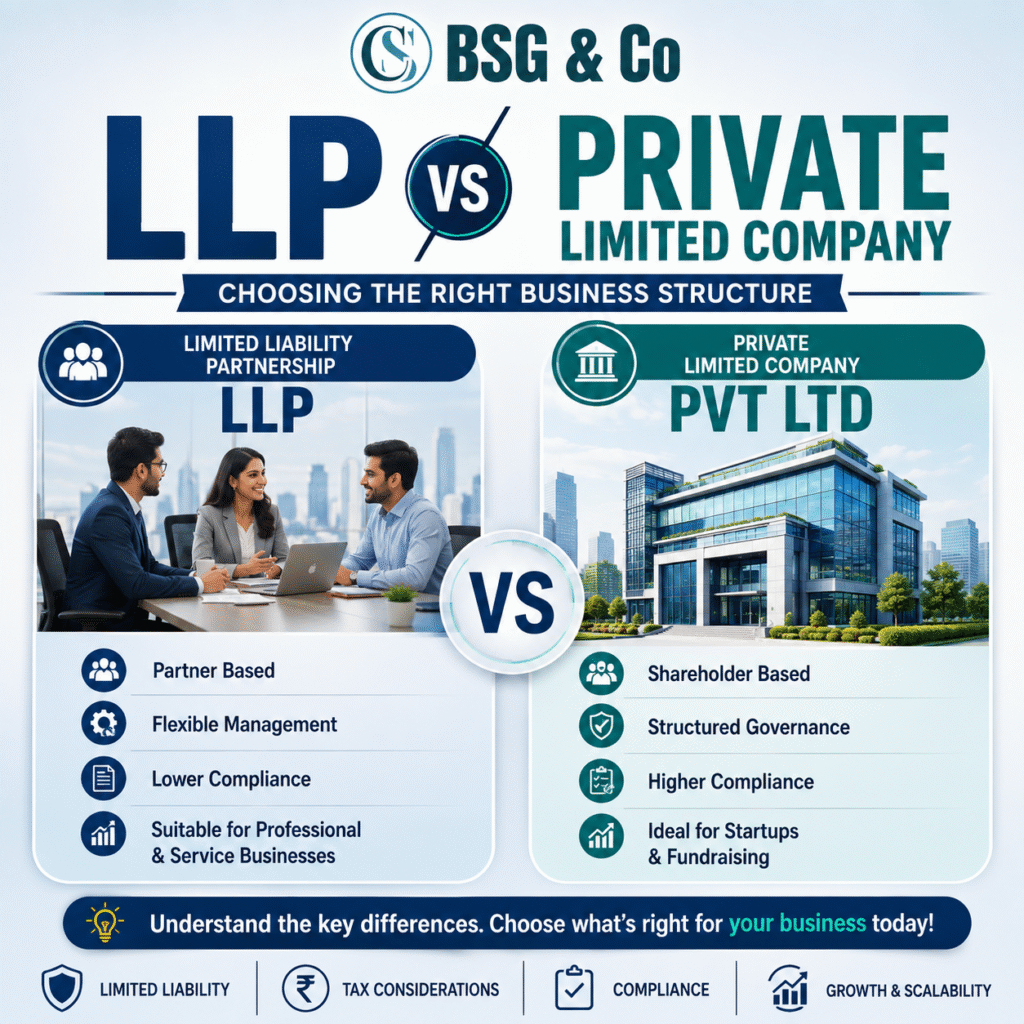
| Feature | Private Limited Company | LLP |
| Legal identity | Separate | Separate |
| Ownership | Shareholders | Partners |
| Management | Directors | Partners/designated partners |
| Liability | Generally limited | Generally limited |
| Ownership transfer | Through shares, subject to restrictions | Governed by LLP Agreement |
| External equity investment | Generally more suitable | Generally less suitable |
| Compliance | Generally higher | Generally moderate |
| Internal flexibility | More structured | More flexible |
| Suitable for | Startups and growth businesses | Partner-led businesses |
The pvt limited vs llp comparison is mainly shaped by the ownership model. A company is built around shares and shareholders, while an LLP is built around partners and contractual arrangements.
Difference in Ownership Structure
Private Limited Company
Ownership is represented by shares held by shareholders. Founders can hold different percentages, and the company can issue or transfer shares subject to applicable law.
This model is useful when ownership may change through funding rounds.
LLP
In an LLP, the relationship between partners is normally documented through the LLP Agreement. It can specify capital contribution, profit-sharing ratios, decision-making rights, responsibilities and procedures for admitting or retiring partners.
This flexibility can be valuable for businesses where partners actively participate in management and share profits according to an agreed formula. That is a key pvt limited vs llp consideration.
Difference in Management and Control
In a Private Limited Company, management follows a formal governance structure. Directors manage the company, while shareholders exercise ownership rights under applicable law, the Articles of Association and other corporate documents.
An LLP is generally more agreement-driven. Partners can define management responsibilities through the LLP Agreement, while designated partners carry specified statutory duties.
Thus, the pvt limited vs llp choice can also be a choice between more formal corporate governance and greater contractual flexibility.
Pvt Limited vs LLP: Liability Comparison
In the pvt limited vs llp comparison, limited liability is an important feature of both structures. Because the entity is legally distinct from its owners, business obligations generally belong to the entity rather than automatically becoming the personal debts of every owner.
However, limited liability is not an absolute personal shield. Personal exposure can arise in situations involving:
- Fraud or dishonest conduct
- Wrongful or unlawful acts
- Personal guarantees
- Breach of specific statutory duties
- Liabilities imposed directly on an individual
Pvt Limited vs LLP: Compliance Requirements
The pvt limited vs llp compliance question is one of the most practical differences.
Private Limited Company
Depending on the company and applicable requirements, obligations may include:
- Annual MCA filings
- Financial statements
- Income tax return
- Board meetings and records
- Statutory registers
- Auditor-related requirements
- Event-based filings
LLP
Depending on the LLP and applicable requirements, obligations may include:
- Annual return
- Statement of Account and Solvency
- Income tax return
- LLP Agreement-related filings where applicable
- Event-based filings
Compliance requirements vary according to the entity’s circumstances. Turnover, contribution, transactions, audit applicability and other conditions can affect obligations. MCA forms, fees, filing procedures and rules can change, so current requirements should be checked before filing.
Pvt Limited vs LLP: Taxation
In the pvt limited vs llp comparison, taxation should be evaluated separately from registration and compliance.
For AY 2026-27, the Income Tax Department states that an LLP is taxed as a firm, while domestic companies are subject to company-specific tax provisions and available regimes. Current company taxation can include different options subject to conditions.
The tax comparison may involve:
- Tax on business profits
- Partner or director remuneration
- Tax treatment of distributions
- Applicable deductions
- TDS
- GST, where applicable
- Transaction-specific tax provisions
Do not choose a structure only because one headline tax rate appears lower. The actual outcome can depend on profits, withdrawals, remuneration, deductions and the owner’s wider tax position. Tax rules change, so current provisions should be verified for the relevant assessment year.
Pvt Limited vs LLP: Investment and Fundraising
For startup founders, fundraising is a decisive part of the pvt limited vs llp comparison.
A Private Limited Company may generally be more suitable for:
- Angel investment
- Venture capital
- Institutional investment
- Multiple equity funding rounds
- Employee stock option arrangements
- Structured founder and investor shareholding
Its share-based model is familiar to equity investors and supports conventional ownership and dilution structures.
An LLP can raise capital through partner contributions and other permitted arrangements, but it does not offer the same conventional share-based investment structure used by many venture-backed startups.
Pvt Limited vs LLP: Which Is Better for Startups?
For the pvt limited vs llp question, there is no universal answer.
Private Limited Company may be suitable when:
- Equity investment is expected
- Rapid growth is planned
- Multiple investors may join
- Share-based ownership is important
- ESOPs may be considered
- Formal corporate governance is desired
LLP may be suitable when:
- The business is partner-driven
- External equity investment is not a priority
- Flexible profit sharing is important
- Partners want contractual management flexibility
- The business is professional or service-oriented
The suitable startup business structure should match the funding model, ownership plans and expected growth.
Pvt Limited vs LLP for Small Businesses
An LLP may work well for a partner-led consulting or professional business. A Private Limited Company may be more suitable for a product or technology business expecting investors and rapid expansion.
Choosing only on the basis of lower compliance can be a mistake. Future restructuring, investment readiness and ownership changes should also be considered.
Difference in Registration Process
For pvt limited vs llp registration, both structures use the MCA framework, but the incorporation process and documents differ.
Private Limited Company
- Obtain DSC where required.
- Complete applicable director identification requirements.
- Select and reserve a suitable name.
- Submit the incorporation application.
- Prepare the Memorandum of Association and Articles of Association.
- Provide registered office details and required documents.
- Complete MCA/ROC processing.
- Receive the Certificate of Incorporation when approved.
LLP
- Obtain applicable DSC.
- Complete partner identification requirements.
- Select and reserve a suitable name.
- Submit the LLP incorporation application.
- Provide partner and registered office details.
- Complete incorporation formalities.
- Execute and file the LLP Agreement as applicable.
- Complete MCA/ROC processing.
Actual forms, fees, timelines and procedures may change, which is another practical pvt limited vs llp consideration.
Difference in Audit and Compliance Burden
Audit requirements should not be reduced to the idea that every company must have the same audit obligations or that every LLP is exempt. Applicability depends on the entity, financial thresholds, contribution, turnover and other conditions under current law.
Businesses may need to consider:
- Statutory audit
- Books of account
- Financial statements
- Annual filings
- Regulatory reporting
- Tax audit or other applicable audits
Pvt Limited vs LLP: Advantages and Disadvantages
| Factor | Private Limited Company | LLP |
| Investment potential | High | Moderate |
| Compliance | Higher | Generally lower |
| Management flexibility | Moderate | High |
| Equity structure | Strong | Limited compared with company shares |
| Investor suitability | High | More limited |
| Profit sharing | Structured through shares | Highly flexible |
| Corporate governance | More formal | Relatively flexible |
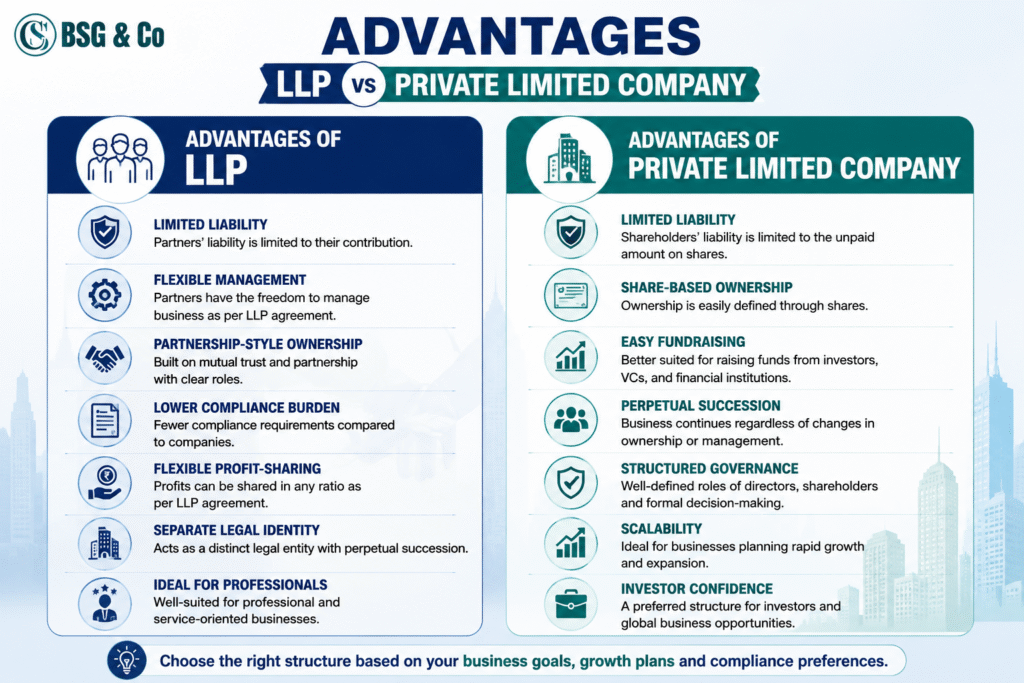
A Private Limited Company can provide a strong framework for investment, structured ownership and scaling, but usually involves more formal governance and compliance.
An LLP can provide flexibility in management and profit sharing and may suit partner-led businesses, but may not fit a venture-capital-oriented ownership model as naturally.
Common Mistakes When Choosing Between Pvt Ltd and LLP
Common mistakes include:
- Choosing only because registration appears cheaper
- Ignoring future fundraising
- Underestimating compliance
- Failing to compare tax consequences
- Poorly defining ownership
- Not considering business risk
- Ignoring future investors
- Not understanding partner or shareholder rights
- Choosing without a long-term growth plan
- Assuming conversion or restructuring will always be simple
The pvt limited vs llp analysis should be completed before incorporation, especially when multiple founders are involved.
How to Choose Between Pvt Ltd and LLP
Use this simple framework:
Question 1: Do you plan to raise equity investment?
If yes, a Private Limited Company may generally be more suitable.
Question 2: Is the business mainly partner-driven?
If yes, an LLP may be worth considering.
Question 3: Do you need flexible profit sharing?
An LLP may provide greater flexibility through its agreement.
Question 4: Do you expect rapid scaling?
A Private Limited Company may offer a suitable framework for certain growth and investment plans.
Question 5: Do you want relatively lower ongoing compliance?
An LLP may have a comparatively lighter framework in some circumstances, but actual obligations still need review.
Pvt Limited vs LLP: Frequently Asked Questions
-
What is the difference between Pvt Limited and LLP?
A Private Limited Company uses shareholders, shares and directors, while an LLP uses partners, designated partners and an LLP Agreement. Both can provide separate legal identity and limited liability, subject to applicable law.
-
Which is better, Pvt Ltd or LLP?
Neither is universally better. The choice depends on funding plans, ownership, management preferences, compliance capacity, business risk and long-term goals.
-
Is LLP better than Private Limited Company for startups?
An LLP can suit partner-led startups that do not prioritise equity investment. A Private Limited Company may suit startups expecting investors, ESOPs or multiple funding rounds.
-
Which is better for fundraising, Pvt Ltd or LLP?
A Private Limited Company is generally more suitable for conventional equity fundraising because ownership is represented through shares. An LLP has a different investment structure.
-
Which has lower compliance, Pvt Ltd or LLP?
An LLP generally has a different and potentially lighter compliance framework, but the actual burden depends on the entity, transactions and current law.
-
Can an LLP be converted into a Private Limited Company?
Conversion or restructuring may be possible subject to applicable law, eligibility conditions, approvals and procedures.
-
Which has better tax benefits, Pvt Ltd or LLP?
There is no universal answer. Tax outcomes depend on current tax law, profits, deductions, remuneration, distributions and the circumstances of the owners.
-
Can a Private Limited Company and LLP have the same founders?
Individuals can participate in different business entities, subject to applicable legal, contractual, tax and regulatory considerations.
Conclusion
The pvt limited vs llp question is not simply about which structure is “better.” It is about which legal and commercial framework fits the business.
A Private Limited Company offers a structured share-based model that can be useful for equity fundraising, formal governance and expansion. An LLP provides greater partnership flexibility and can work well for professional, consulting and other partner-led businesses.
Compliance, taxation, ownership, liability, management and fundraising all differ. Entrepreneurs should therefore consider their objectives, growth plans, investment strategy, risk profile and ability to manage ongoing obligations before selecting a structure.
Where circumstances are complex, founders may seek qualified legal, tax, accounting or corporate compliance advice based on their specific situation.
BSG & Co
Phone: +91-8660360492
Email: bhaskar@bhaskarbhatandco.in
Website: www.csfirmbsg.com
Address: 2nd Floor, 66, 13th Main Rd, 4th T Block East, 4th Block, Jayanagar, Bengaluru, Karnataka 560011