
Limited Liability Partnership vs Private Limited Company in India: Which Is Better for Your Business?
Choosing the right business structure is an important decision for every entrepreneur. Whether you are starting a consultancy, IT company, digital marketing agency or technology startup, selecting between an LLP and a Private Limited Company can influence your ownership, taxation, legal responsibilities and future growth.
Understanding limited liability partnership vs private limited company is essential before registering your business. Both structures provide a separate legal identity and limited liability protection, but they differ in management, compliance, fundraising and taxation.
For example, two professionals starting a consultancy may prefer an LLP because of its flexible management. However, entrepreneurs planning to build a technology startup and attract investors may find a Private Limited Company more suitable.
This article explains the differences to help you choose the right business structure in India.
-
What Is a Limited Liability Partnership (LLP)?
A Limited Liability Partnership (LLP) is a business structure governed by the Limited Liability Partnership Act, 2008. It combines the flexibility of a traditional partnership with the benefits of a separate legal identity and limited liability.
An LLP can own property, enter into contracts, open bank accounts and conduct business independently of its partners.
Key features of an LLP:
- Minimum two partners are required.
- At least two designated partners must be individuals.
- At least one designated partner must satisfy the resident-in-India requirement.
- There is no general statutory maximum number of partners.
- Partners generally have limited liability.
- Management and profit-sharing arrangements are governed by the LLP Agreement.
- The LLP has perpetual succession.
Example: Two professionals starting a consultancy in Bangalore can register an LLP and decide their investment, responsibilities and profit-sharing ratios through an LLP Agreement.
This structure is suitable for professional firms, consultants and businesses managed directly by their partners.
-
What Is a Private Limited Company?
A Private Limited Company is incorporated under the Companies Act, 2013. It is a separate legal entity whose ownership is divided into shares.
It is commonly preferred by startups and businesses planning expansion, external investment and structured ownership.
Key features:
- Minimum two shareholders.
- Minimum two individual directors.
- Maximum 200 members, subject to statutory exceptions.
- Share-based ownership.
- Limited liability for shareholders, subject to applicable exceptions.
- Formal corporate governance.
- Memorandum of Association (MOA) and Articles of Association (AOA).
- Perpetual succession.
Example: Two founders establish a software company. Founder A owns 60% of the shares, while Founder B owns 40%.
They may also become directors. However, shareholders own the company, whereas directors manage its affairs.
-
Limited Liability Partnership vs Private Limited Company: Key Differences
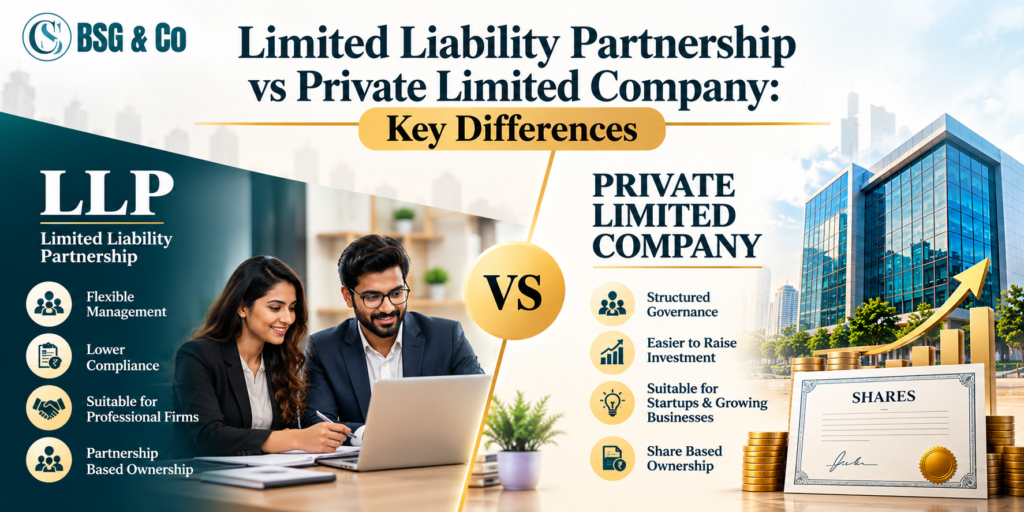
The following comparison explains the major differences between both structures.
| Comparison factor | LLP | Private Limited Company |
| Governing law | LLP Act, 2008 | Companies Act, 2013 |
| Legal identity | Separate entity | Separate entity |
| Minimum owners | 2 partners | 2 shareholders |
| Management | Partners | Directors |
| Ownership | Partnership interests | Shares |
| Liability | Generally limited | Generally limited |
| Ownership transfer | Subject to LLP Agreement | Subject to law and AOA |
| Fundraising | Less suitable for equity funding | Suitable for equity investment |
| Foreign investment | Subject to FDI rules | Subject to FDI rules |
| Compliance | Generally simpler | Generally more extensive |
| Audit | Subject to applicable thresholds | Generally compulsory |
| Management flexibility | More flexible | Formal governance |
| Business continuity | Perpetual succession | Perpetual succession |
| Suitable for | Consultancy and professional firms | Startups and growing businesses |
Important Differences Explained
Ownership: LLP partners hold partnership interests, while company shareholders own shares. Changes in ownership follow different legal procedures.
Management: LLP partners can establish flexible management arrangements. In a company, directors manage operations while shareholders exercise ownership rights.
Fundraising: Private Limited Companies can issue shares to investors, subject to applicable laws. LLPs cannot issue equity shares like companies.
Business growth: Both structures can expand. However, companies generally offer a more familiar ownership structure for venture capital, angel investment and ESOPs.
-
Difference in Ownership and Management Structure
In an LLP, partners generally participate in management according to the LLP Agreement. Designated partners have additional statutory compliance responsibilities.
In a Private Limited Company, ownership and management are separate:
- Shareholders own the company.
- Directors manage company operations.
- The Board takes decisions according to applicable corporate law.
For example, two founders can establish an LLP with a 60:40 profit-sharing arrangement. Alternatively, they can incorporate a company with 60:40 shareholding.
If they later introduce investors, a company may provide a more convenient structure for issuing shares and adjusting ownership.
-
Difference in Compliance Requirements
Compliance is an important consideration when comparing LLPs and Private Limited Companies.
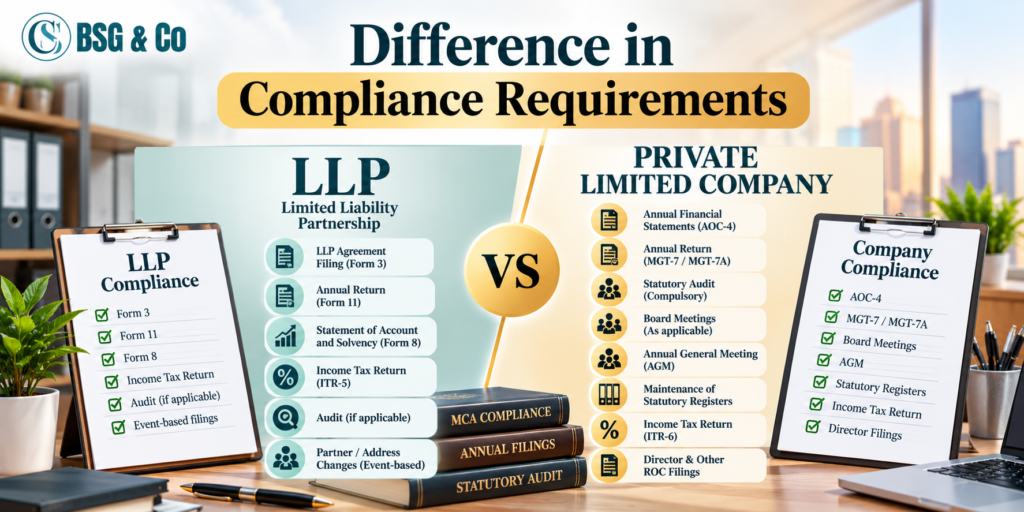
LLP Compliance Requirements
An LLP generally needs to complete:
- LLP Agreement filing through Form 3.
- Annual Return in Form 11.
- Statement of Account and Solvency in Form 8.
- Applicable income tax return.
- Statutory audit, where applicable.
- Event-based filings for partner and address changes.
Private Limited Company Compliance Requirements
A company generally needs to complete:
- Annual financial statement filing through AOC-4.
- Annual return through MGT-7 or MGT-7A, as applicable.
- Statutory audit.
- Income tax return.
- Applicable Board meetings.
- Annual General Meeting.
- Maintenance of statutory registers.
- Director-related and other ROC filings.
| Compliance | LLP | Private Limited Company |
| Annual return | Form 11 | MGT-7/MGT-7A |
| Financial statements | Form 8 | AOC-4 |
| Statutory audit | Threshold-based | Generally compulsory |
| Board meetings | Not applicable | Applicable |
| AGM | Not applicable | Generally required |
| Income tax return | Applicable LLP return | Applicable company return |
Audit clarification: An LLP is generally required to undergo statutory audit when its turnover exceeds ₹40 lakh or its contribution exceeds ₹25 lakh. A Private Limited Company generally requires statutory audit irrespective of turnover or profit.
Actual compliance requirements depend on applicable exemptions, business activities and current law.
-
LLP vs Private Limited Company: Taxation Differences
Taxation is another important factor in the limited liability partnership vs private limited company decision.
LLP taxation: An LLP is taxed as a partnership entity under applicable income tax provisions. Partner remuneration and interest may be deductible subject to prescribed conditions and limits. Eligible profit shares distributed to partners are generally exempt in their hands under the applicable provisions.
Private Limited Company taxation: Domestic companies may qualify for different corporate tax regimes depending on eligibility and applicable conditions. Dividends received by shareholders are generally taxable in their hands.
From 1 April 2026, the Income-tax Act, 2025 applies to Tax Year 2026–27 onwards. Earlier tax years continue under the previous law’s transition provisions.
The better option depends on profitability, reinvestment plans, partner remuneration, dividend distribution and applicable tax provisions. Professional tax advice is recommended before incorporation.
-
LLP vs Private Limited Company: Registration Cost
The registration cost varies depending on government charges, stamp duty and professional service requirements.
| Cost component | LLP | Private Limited Company |
| Government fees | MCA charges | MCA charges |
| Stamp duty | State-specific | State-specific |
| DSC | Required | Required |
| Professional fees | Service-dependent | Service-dependent |
| Documentation | LLP Agreement | MOA and AOA |
| Annual expenses | Applicable filings | Filings and audit |
The LLP registration cost and Private Limited Company registration cost depend on partner or shareholder details, contribution or capital, state-specific stamp duty and professional fees.
Obtain a detailed quotation before selecting a structure.
-
Which Is Better for Startups and Investors?
The right choice depends on your business objectives.

When Should You Choose an LLP?
Consider an LLP if you:
- Operate a consultancy or professional firm.
- Run a small service-based business.
- Have a limited group of partners.
- Prefer flexible management.
- Do not expect conventional equity investment.
- Want relatively simpler compliance.
When Should You Choose a Private Limited Company?
Consider a Private Limited Company if you:
- Are establishing a technology startup.
- Plan to raise angel or venture capital investment.
- Want to introduce multiple shareholders.
- Plan to implement ESOPs.
- Expect significant expansion.
- Need structured equity ownership.
These are general recommendations. Investor expectations, industry regulations and funding arrangements should also be evaluated.
-
Can an LLP Be Converted Into a Private Limited Company?
Yes. An LLP may be registered as a company under Section 366 of the Companies Act, 2013, subject to applicable eligibility and procedural requirements.
Businesses generally consider conversion when they plan to raise equity investment, expand operations or introduce a share-based ownership structure.
The process may involve:
- Reviewing the LLP’s legal and financial position.
- Checking eligibility and statutory requirements.
- Obtaining necessary approvals.
- Preparing incorporation documents.
- Filing Form URC-1 and linked incorporation forms, as applicable.
- Completing subsequent statutory formalities.
Tax implications, assets, liabilities, contracts and regulatory approvals should be reviewed before conversion.
-
Common Mistakes to Avoid When Choosing a Business Structure
Entrepreneurs should avoid these mistakes:
- Selecting a structure only because of lower registration costs.
- Ignoring future fundraising requirements.
- Not defining ownership responsibilities.
- Overlooking the LLP Agreement or AOA.
- Ignoring annual compliance expenses.
- Failing to consider taxation.
- Assuming limited liability removes every personal risk.
- Not understanding statutory audit requirements.
- Ignoring future expansion plans.
Professional guidance before incorporation can help prevent unnecessary legal and financial complications.
-
LLP Registration and Private Limited Company Registration in Bangalore
Bengaluru has a growing business ecosystem with IT companies, consultants, freelancers, startups and professional service firms.
Entrepreneurs searching for LLP registration in Bangalore or Private Limited Company registration in Bangalore should evaluate their business requirements before starting the MCA registration process.
An experienced Company Secretary in Bangalore can assist with:
- Business structure selection.
- Partner and shareholder arrangements.
- Business name selection.
- DSC coordination.
- MCA incorporation documentation.
- LLP Agreement preparation.
- MOA and AOA guidance.
- Registration and filing support.
- Post-registration compliance planning.
-
How BSG & Co Can Help
BSG & Co is a Bengaluru-based Company Secretary and corporate compliance firm assisting entrepreneurs and businesses with incorporation and corporate legal matters.
The firm can assist with:
- LLP registration guidance.
- Private Limited Company incorporation.
- Business structure selection.
- Partner and shareholder documentation.
- MCA incorporation form preparation and filing support.
- LLP Agreement preparation guidance.
- MOA and AOA guidance.
- Annual ROC compliance.
- LLP annual filing support.
- Director appointment and resignation filings.
- Corporate law advisory support.
BSG & Co focuses on accurate documentation, transparent communication and practical compliance guidance.
Contact BSG & Co
Phone: +91-8660360492
Email: bhaskar@bhaskarbhatandco.in
Website: www.csfirmbsg.com
Address: 2nd Floor, 66, 13th Main Rd, 4th T Block East, 4th Block, Jayanagar, Bengaluru, Karnataka 560011
Contact BSG & Co for professional assistance with LLP registration, Private Limited Company incorporation and corporate compliance services in Bangalore.
- Frequently Asked Questions
- What is the difference between an LLP and a Private Limited Company?
An LLP is owned by partners and managed according to an LLP Agreement. A Private Limited Company is owned by shareholders through shares and managed by directors.
- Which is better, LLP or Private Limited Company?
An LLP may suit consultancy and professional firms. A Private Limited Company may be preferable for startups seeking equity investment and structured expansion.
- Is LLP cheaper than a Private Limited Company?
An LLP may have lower ongoing compliance expenses, but actual registration and maintenance costs depend on government fees, stamp duty and professional charges.
- Which structure has fewer compliance requirements?
An LLP generally has fewer corporate governance requirements than a Private Limited Company, although both must complete applicable statutory filings.
- Can an LLP raise funds from investors?
Yes. An LLP can receive partner contributions and permissible financing, but cannot issue equity shares like a company.
- Can a Private Limited Company have two shareholders?
Yes. A Private Limited Company requires at least two shareholders, who may hold different ownership percentages.
- What is the minimum number of partners required for an LLP?
An LLP requires at least two partners under the LLP Act, 2008.
- What is the minimum number of directors required for a Private Limited Company?
A Private Limited Company must have at least two individual directors.
- Which structure is better for startups?
A Private Limited Company is generally preferred by startups planning angel investment, venture capital funding and ESOPs.
- Which structure is better for a consultancy business?
An LLP is often suitable for consultancy businesses because it offers flexible partner management and profit-sharing arrangements.
- Is statutory audit compulsory for an LLP?
Audit is generally required when turnover exceeds ₹40 lakh or partner contribution exceeds ₹25 lakh.
- Is statutory audit compulsory for a Private Limited Company?
Yes. A Private Limited Company generally requires statutory audit irrespective of turnover or profitability.
- What is the difference in taxation between LLP and Private Limited Company?
LLPs are taxed under applicable firm provisions, whereas companies follow applicable corporate tax provisions. Profit distributions and dividends also have different tax treatments.
- Can an LLP be converted into a Private Limited Company?
Yes. Conversion is possible under Section 366 of the Companies Act, 2013, subject to applicable legal and procedural requirements.
- Can foreign nationals become LLP partners or company shareholders?
Yes, subject to applicable foreign investment regulations, sectoral restrictions, entry routes and other legal requirements.
- Can an LLP issue shares?
No. An LLP has partnership interests rather than equity shares. Companies can issue shares under applicable company law.
- What are the annual compliance requirements for an LLP?
An LLP generally files Form 11, Form 8 and its applicable income tax return, along with other required statutory filings.
- What are the annual compliance requirements for a Private Limited Company?
Companies generally file annual financial statements, annual returns and income tax returns, conduct statutory audits and complete applicable meetings and ROC filings.
- Can BSG & Co help with LLP and Private Limited Company registration in Bangalore?
Yes. BSG & Co provides incorporation guidance, MCA filing support, LLP documentation, MOA and AOA guidance and corporate compliance assistance, subject to its service scope.
- Conclusion: Choose the Right Business Structure for Long-Term Growth
The decision of limited liability partnership vs private limited company depends on your business model, ownership preferences, funding requirements and long-term objectives.
An LLP may be suitable for consultants, professional firms and partner-led businesses that prefer flexible management and relatively simpler compliance.
A Private Limited Company may be more appropriate for startups and growing businesses planning equity investment, ESOPs and structured expansion.
Before registration, carefully evaluate taxation, liability, compliance expenses and future ownership requirements.
Planning to start a business in Bangalore? Contact BSG & Co, Jayanagar, Bengaluru, for professional guidance on LLP registration, Private Limited Company incorporation and corporate compliance services.
BSG & Co
Phone: +91-8660360492
Email: bhaskar@bhaskarbhatandco.in
Website: www.csfirmbsg.com
Address: 2nd Floor, 66, 13th Main Rd, 4th T Block East, 4th Block, Jayanagar, Bengaluru, Karnataka 560011