
Director Appointment: The Right Director. The Right Process. Stronger Governance.
Director appointment in India is an important corporate action because directors form the core of a company’s board and participate in decisions affecting strategy, finance, compliance and governance. Under the Companies Act, 2013, adding a director is not simply about entering a name in company records. The company must identify the appropriate legal route, verify eligibility, obtain the required consent and approvals, complete the applicable MCA filing, and update statutory records.
For founders, shareholders and existing directors, understanding the director appointment process can help prevent avoidable compliance errors. The exact procedure can vary depending on the company’s type, the role being filled and the circumstances of the appointment. Current MCA forms, fees and filing procedures should always be verified before submission.
What Is Director Appointment?
A director is an individual who serves on the Board of Directors and participates in the management, supervision and governance of a company. The Companies Act, 2013 provides the principal legal framework governing directors of companies in India. Section 152 generally provides that directors are appointed by the company in general meeting unless the Act provides otherwise. It also addresses DIN, declarations and consent requirements.
In practical terms, director appointment means formally bringing an eligible individual onto the company’s board through the procedure applicable to that particular situation.
Directors are different from shareholders. Shareholders generally hold ownership interests in the company, while directors are responsible for participating in board-level decisions and fulfilling statutory duties.
A proper appointment normally requires:
- Checking the Articles of Association
- Verifying director eligibility
- Confirming DIN requirements
- Obtaining consent to act as director
- Passing the appropriate resolution
- Obtaining shareholder approval where applicable
- Completing the applicable MCA filing
- Updating statutory registers and corporate records
The Articles of Association may also contain provisions relevant to the appointment process, so they should be reviewed before action is taken.
Why Is the Appointment of a Director Important?
A company may need to appoint a director for several commercial or legal reasons. A well-planned director appointment can strengthen the board while ensuring that the company has the expertise and governance structure it needs.
Common reasons include:
- Incorporation of a new company
- Replacement of an outgoing director
- Expansion of the board
- Bringing specialised industry or financial expertise
- Strengthening corporate governance
- Meeting applicable minimum-director requirements
- Supporting strategic business decisions
- Meeting investor or shareholder expectations
- Expanding into new markets or business activities
A company director should not be treated merely as a name on corporate records. Directors may have statutory duties and responsibilities, including acting in accordance with applicable law, exercising appropriate care and diligence, and considering the interests of the company and other stakeholders where required.
Eligibility Requirements for Becoming a Director
Before proceeding with a director appointment, the company should verify whether the proposed individual satisfies the applicable statutory requirements.
Important considerations generally include:
Individual Person
A director must be an individual. A company or other artificial legal person cannot itself be appointed as a director of an Indian company.
DIN
The proposed director generally needs a Director Identification Number (DIN). Section 152 specifically states that a person cannot be appointed as a director unless allotted a DIN under the applicable provisions.
Consent to Act
A person appointed as a director must provide consent to hold office. Section 152 requires the consent to be filed with the Registrar within the prescribed period and manner.
Declarations and Documents
The proposed director may need to provide declarations confirming that applicable disqualification provisions do not prevent the appointment, along with identity and address documentation.
Director Disqualification
The company should also conduct appropriate checks under the applicable disqualification provisions before finalising the appointment.
Disqualification of Directors
Director disqualification is an important part of the compliance review. Section 164 of the Companies Act, 2013 contains statutory disqualification provisions, while other provisions may affect a person’s ability to hold office.
Broad areas that may require review include:
- Certain relevant court orders
- Insolvency-related circumstances
- Specified criminal convictions
- Certain company filing defaults
- Defaults relating to statutory obligations
- Other circumstances prescribed under company law
The exact application of these provisions depends on the facts and the current law. Disqualification rules can be technical, particularly where an individual has held directorships in several companies or where companies have outstanding statutory defaults.
Therefore, eligibility should be checked before the company passes the final resolution rather than after the filing has been submitted.
Types of Directors in India
Different categories of directors exist under Indian company law. The role and appointment requirements can vary depending on the category.

Executive Director
An executive director generally has management or operational responsibilities in addition to board responsibilities. Depending on the role, the person may be involved in the day-to-day affairs of the company.
Non-Executive Director
A non-executive director generally focuses on board-level oversight, governance and strategic supervision rather than routine operational management.
Independent Director
An independent director is subject to specific eligibility, independence and other statutory requirements. Independent directors are particularly relevant to specified classes of companies. Their appointment also involves prescribed shareholder approval and additional disclosures.
Additional Director
An additional director may be appointed by the board where the applicable statutory conditions are satisfied. The appointment is subject to the relevant provisions of the Companies Act and the applicable time limitations.
Nominee Director
A nominee director is generally nominated to represent the interests of an eligible institution, government authority, stakeholder or other person where the law or an applicable agreement permits such an arrangement.
Alternate Director
An alternate director may be appointed in specified circumstances when a director is absent from India for the period and under the conditions prescribed by law.
Managing Director and Whole-Time Director
A managing director and a whole-time director have more extensive executive responsibilities than an ordinary non-executive board member. Their appointment may involve additional statutory conditions, approvals and disclosures.
Minimum Number of Directors Required
The Companies Act establishes different minimum board requirements for different company structures. Broadly:
| Company type | General minimum number of directors |
| Private Limited Company | 2 |
| Public Company | 3 |
| One Person Company | 1 |
Companies should also consider the applicable resident-director requirement. Special provisions, exemptions and specific company classifications may affect how these requirements apply.
The board should therefore review the company’s current structure before adding or removing a director, particularly when a resignation is occurring at the same time.
Documents Required for Director Appointment
The documents required can differ depending on the nature of the appointment and the proposed director’s circumstances.
Documents from the Proposed Director
Commonly requested documents include:
- PAN card
- Aadhaar or another accepted identity document
- Passport, where applicable
- Address proof
- Recent photograph
- DIN
- Digital Signature Certificate (DSC), where required
- Consent to act as director
- Applicable declarations
For foreign nationals or foreign-resident individuals, additional documentation, certification or authentication requirements may apply.
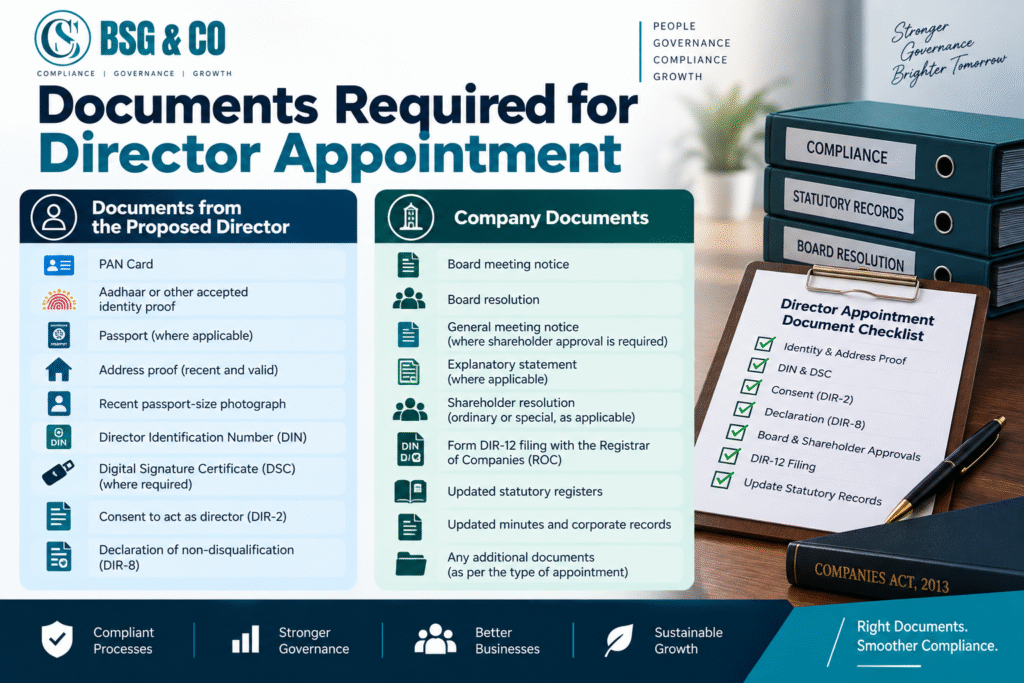
Company Documents
The company may also need:
- Board meeting notice
- Board resolution
- General meeting notice, where applicable
- Explanatory statement, where required
- Shareholder resolution, where applicable
- DIR-12 filing
- Updated statutory registers
- Updated minutes and corporate records
The precise documentation should be determined from the type of appointment and the applicable provisions rather than relying on a generic checklist.
Step-by-Step Director Appointment Process
A structured director appointment process can generally be approached as follows.
Step 1: Check the Need for Appointment
First, identify why the company needs the new director. The reason may be a vacancy, business expansion, governance requirement, investor request or a need for specialised expertise.
Step 2: Verify Eligibility
Check the proposed individual’s DIN, consent, declarations and statutory eligibility. The company should also consider applicable disqualification provisions.
Step 3: Obtain Required Documents
Collect identity proof, address proof, consent, declarations and any other documents required for the particular appointment.
Step 4: Conduct the Board Meeting
Where board action is applicable, the directors consider the proposed candidate and pass the appropriate board resolution. The notice, agenda and minutes should accurately record the matter.
Step 5: Obtain Shareholder Approval Where Required
Certain appointments require approval by members in a general meeting. Depending on the circumstances, this may involve an ordinary resolution or a special resolution.
Step 6: File Form DIR-12
Form DIR-12 is used to report prescribed changes relating to directors and certain key managerial personnel to the Registrar of Companies. The applicable filing should contain accurate information and supporting documents as required.
The Companies Act requires consent to hold office to be filed with the Registrar within the prescribed period.
Step 7: Update Statutory Records
After completion, update the company’s statutory registers, minutes, internal records and other relevant corporate documentation.
Step 8: Communicate the Appointment
Where necessary, the company should update banks, investors, internal teams, counterparties and other relevant stakeholders.
Because MCA systems, forms and filing procedures can change, the latest MCA instructions should be checked before filing. The MCA currently operates its company filings through the V3 system and periodically publishes updates affecting forms and filing processes.
Board Resolution for Director Appointment
A board resolution provides formal evidence of the board’s decision where board approval is required. A carefully prepared resolution should reflect the actual circumstances rather than using an unsuitable generic format.
Depending on the circumstances, it may include:
- Name of the proposed director
- DIN
- Effective date
- Relevant statutory provisions
- Nature or category of appointment
- Approval or recommendation to members, where applicable
- Authorisation for the applicable MCA filing
- Authorisation for maintaining company records
The wording should correspond with the Articles of Association, the Companies Act and the actual approval mechanism being used.
Shareholder Approval for Appointment
Although board involvement is important, some appointments require approval by shareholders in a general meeting. Section 152 establishes general meeting appointment as the normal route unless the Act provides otherwise.
The company may need to prepare:
- Notice of general meeting
- Explanatory statement, where applicable
- Details of the proposed director
- Relevant declarations
- Ordinary resolution or special resolution, depending on the legal requirement
- Minutes and voting records
Independent-director appointments, for example, have specific shareholder approval requirements under the Companies Act.
MCA Filing and Form DIR-12
MCA filing is an important part of documenting changes to the board. DIR-12 is generally used for reporting appointments, cessations and other prescribed changes relating to directors and specified key managerial personnel.
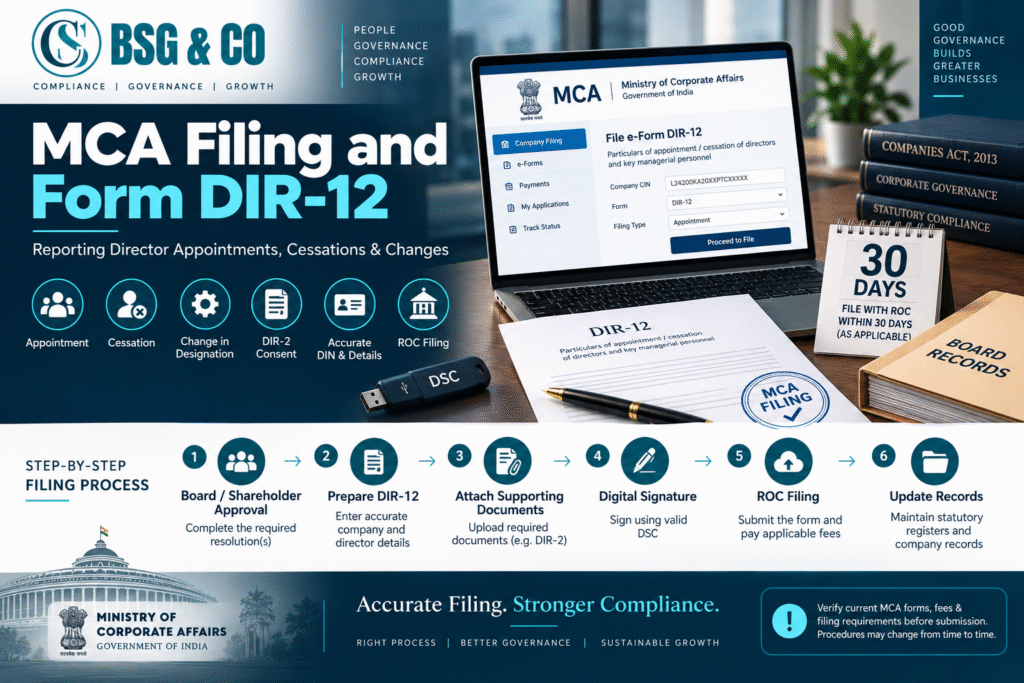
The company should ensure that:
- The correct company details are entered
- DIN information is accurate
- Names match official records
- Supporting documents are complete
- Digital signatures are properly applied
- The applicable filing is submitted within the prescribed statutory period
- Any MCA resubmission or correction requirement is addressed promptly
Incorrect information can lead to additional compliance work, resubmission or potential consequences under applicable law.
Since MCA forms and electronic filing processes are periodically revised, companies should rely on the current MCA portal instructions rather than old screenshots, templates or filing guides.
Director Appointment Fees and Costs
The cost of appointing a director depends on the circumstances. Possible components include:
- Government filing fees
- Fees linked to applicable company filing requirements
- State-specific stamp duty, where applicable
- DSC-related costs
- Professional fees, if any
- Costs associated with additional filings
- Costs arising from special or complex circumstances
There is no single universal cost applicable to every company. Statutory government charges should also be distinguished from professional service fees.
Before filing, companies should verify the current MCA fee structure and applicable charges rather than relying on an old fee chart.
How Long Does Director Appointment Take?
There is no universal fixed timeline for every director appointment. The duration may depend on:
- Availability or allotment of DIN
- Readiness of documents
- Board meeting schedule
- Requirement for shareholder approval
- Availability of DSC
- MCA filing requirements
- Processing or technical issues
- Resubmission or correction requirements
- Special regulatory approvals, where applicable
For a straightforward case with complete documentation, the administrative work may be relatively quick. However, companies should avoid promises that an appointment will always be completed within a particular number of hours or days.
Common Mistakes to Avoid
Companies can reduce compliance problems by avoiding the following mistakes:
- Appointing an ineligible individual
- Failing to verify DIN
- Missing consent documentation
- Entering incorrect PAN or identity details
- Using inconsistent addresses
- Missing board approval
- Missing required shareholder approval
- Delaying MCA filing
- Entering incorrect DIR-12 information
- Failing to update statutory registers
- Ignoring director disqualification
- Assuming a new appointment automatically removes an existing director
- Failing to review resident-director requirements
A useful internal checklist should be completed before filing and again after the appointment is recorded.
Director Appointment vs Director Resignation
Appointment and resignation are separate corporate actions and should not be treated as opposite entries in a single administrative process.
| Aspect | Director Appointment | Director Resignation |
| Purpose | Adds a director | Records departure of a resigning director |
| Initiated By | Company/shareholders as applicable | Usually the director |
| Key Documentation | Consent and appointment documents | Resignation letter and related records |
| MCA Filing | Applicable change filing | Applicable change filing |
| Board Action | Generally required as applicable | Required for noting/recording |
| Statutory Records | Updated | Updated |
When a director leaves and another person joins, both actions should be documented separately and the resulting board composition should be checked against statutory requirements.
Post-Appointment Compliance
Completing the appointment does not end the company’s compliance responsibilities.
After the director joins the board, the company should consider:
- Updating statutory registers
- Maintaining board minutes
- Obtaining applicable director disclosures
- Recording interests in other entities where required
- Monitoring conflict-of-interest requirements
- Maintaining board meeting records
- Completing annual compliance
- Monitoring DIN-related obligations
- Reporting future changes to the MCA
- Maintaining accurate corporate records
The obligations may differ according to company type, director category and the individual’s responsibilities.
Why Proper Director Appointment Matters for Corporate Governance
Good corporate governance depends on having a properly constituted and active board. A compliant director appointment helps establish accountability and provides a clear record of who is responsible for board-level decisions.
A strong board can contribute to:
- Accountability
- Transparency
- Strategic decision-making
- Risk management
- Regulatory compliance
- Stakeholder confidence
- Effective board oversight
A person accepting a board position should understand the statutory duties and responsibilities associated with being a director. The position should not be accepted merely because a company needs to fill a vacancy.
Frequently Asked Questions About Director Appointment
-
What is director appointment in India?
It is the formal process through which an eligible individual becomes a member of a company’s Board of Directors in accordance with applicable company law, the Articles of Association and required corporate approvals.
-
Who can be appointed as a director?
An individual who satisfies applicable eligibility requirements, has the required DIN, provides consent and is not subject to relevant statutory disqualification may generally be considered, subject to the specific circumstances.
-
Is DIN mandatory for a director?
Yes. Section 152 states that a person cannot be appointed as a director unless the person has been allotted a DIN under the applicable provisions.
-
Is shareholder approval required for director appointment?
It depends on the type of appointment and the applicable legal provision. Section 152 generally provides for appointment by the company in general meeting unless the Act provides otherwise.
-
What is Form DIR-12?
DIR-12 is an MCA form used for reporting prescribed changes concerning directors and specified key managerial personnel, including applicable appointments and cessations.
-
What documents are required for appointing a director?
Common documents include PAN, identity and address proof, DIN, consent to act, applicable declarations and DSC where required. Company approvals and filing documents may also be necessary.
-
Can a director be appointed without a board meeting?
The answer depends on the particular appointment route. Some appointments involve direct member approval, while others can involve board powers provided under the Companies Act and applicable Articles. The relevant legal provision should be checked before proceeding.
-
How long does director appointment take?
There is no universal timeline. It depends on documentation, DIN status, approvals, DSC, MCA filing and whether corrections or additional requirements arise.
Conclusion
A director appointment should be treated as a substantive corporate governance action rather than a routine administrative change. Companies need to select an eligible individual, verify DIN and disqualification status, obtain consent, follow the correct board or shareholder approval process, complete applicable MCA filings and update statutory records.
The Companies Act, 2013 contains several provisions dealing with directors, including appointment, DIN, additional directors, disqualifications and related matters.
Because MCA forms, fees, electronic filing procedures and regulatory requirements can change, companies should verify the current requirements before filing. For complex situations involving independent directors, nominee directors, foreign individuals, disqualifications, restructuring or unusual board arrangements, professional legal or corporate-secretarial guidance may be useful.
The safest approach is to document every applicable step carefully and ensure that the company’s board records, statutory registers and MCA records remain consistent.
BSG & Co
Phone: +91-8660360492
Email: bhaskar@bhaskarbhatandco.in
Website: www.csfirmbsg.com
Address: 2nd Floor, 66, 13th Main Rd, 4th T Block East, 4th Block, Jayanagar, Bengaluru, Karnataka 560011