
LLP vs Private Limited Company: Understand the Key Differences and Choose the Right Structure
Choosing the right legal structure is one of the most important decisions when starting a business in India. The structure you select can affect ownership, management, taxation, compliance, fundraising, and the way the business grows over time. For many entrepreneurs, the choice often comes down to an LLP vs Private Limited Company.
A Limited Liability Partnership (LLP) combines partnership-style flexibility with limited liability protection. A Private Limited Company, on the other hand, follows a more formal corporate structure based on shareholders and directors. Neither structure is automatically better for every business.
The right choice depends on factors such as the number of founders, nature of the business, investment plans, desired management style, compliance capacity, and long-term expansion objectives. Understanding the LLP vs Private Limited Company distinction can therefore help entrepreneurs select a structure that matches their business strategy rather than simply choosing the most popular option.
What Is an LLP?
A Limited Liability Partnership is a separate legal entity registered under the Limited Liability Partnership Act, 2008. It combines elements of a traditional partnership with limited liability protection.
An LLP generally has partners who contribute capital or other agreed contributions to the business. At least two designated partners are required, subject to the applicable legal requirements, and the partners can establish their internal rights and responsibilities through an LLP agreement.
Important features include:
- Separate legal identity from its partners
- Limited liability, subject to applicable law
- Partnership-based management
- Flexible profit-sharing arrangements
- Designated partners responsible for statutory obligations
- Greater flexibility in internal arrangements
- Suitability for professional and closely held businesses
For businesses where the founders are actively involved and external equity investment is not an immediate priority, an LLP can provide a practical business structure in India.
LLP registration in India involves MCA registration and compliance with applicable requirements. Although its compliance framework may be lighter than that of a company in many circumstances, an LLP is still required to maintain appropriate records and complete prescribed filings.
What Is a Private Limited Company?
A Private Limited Company is a separate legal entity incorporated under the Companies Act, 2013. Its ownership is represented through shares held by shareholders, while directors are responsible for managing the company’s affairs.
The Private Limited Company structure is more formal than an LLP. It provides a defined framework for shareholding, board governance, decision-making, and transfer of ownership.
Key characteristics include:
- Separate legal identity
- Limited liability of shareholders
- Ownership through shares
- Directors responsible for management
- Perpetual succession
- Formal corporate governance
- Ability to issue and transfer shares subject to applicable restrictions
- Greater suitability for equity-based fundraising
Private Limited Company registration is therefore commonly considered by businesses intending to build a scalable corporate structure, particularly where outside investors may become involved.
The LLP vs Private Limited Company decision becomes particularly important when founders are thinking beyond initial incorporation and considering how ownership and investment may evolve.
LLP vs Private Limited Company – Key Differences
The following table provides a practical overview of the major differences:
| Factor | LLP | Private Limited Company |
| Legal structure | Partnership-based legal entity | Corporate legal entity |
| Ownership | Partners | Shareholders |
| Minimum participants | At least 2 partners, including designated partner requirements | At least 2 members and 2 directors, subject to applicable law |
| Liability | Generally limited to applicable contribution/obligations, subject to exceptions | Generally limited to unpaid share capital, subject to exceptions |
| Management | Partners and designated partners | Directors and board |
| Internal flexibility | Generally high | More formal |
| Compliance | Generally lighter, depending on circumstances | Generally more extensive |
| Annual filings | Prescribed LLP filings | Annual return and financial statement filings |
| Investment opportunities | Less suited to conventional equity investment | Well suited to equity investment |
| Ownership transfer | Governed by agreement and applicable law | Share transfer subject to law and company documents |
| Fundraising | Partner contributions and other permissible arrangements | Equity shares and other permitted instruments |
| Tax considerations | Taxed as a firm/LLP under applicable provisions | Taxed under company tax provisions |
| Business suitability | Professional, partnership-oriented and closely held businesses | Startups, scalable businesses and investment-led ventures |
The difference between LLP and Private Limited Company is therefore not limited to registration. It extends to ownership, governance, funding, compliance, and future business strategy.
Difference in Ownership and Management
In an LLP, the partners generally have considerable freedom to determine how the business is managed. The LLP agreement can specify capital contributions, profit-sharing arrangements, decision-making procedures, responsibilities, and other internal matters.
Designated partners also have specific statutory responsibilities.
A company works differently. Shareholders own the company through shares, while directors manage its affairs. The Articles of Association and applicable provisions of the Companies Act establish the governance framework.
This distinction means that an LLP vs Private Limited Company assessment should consider how actively founders want to participate in management and how formal they want the decision-making process to be.
LLP vs Private Limited Company – Liability Protection
Both structures provide limited liability protection, which is one of their major advantages over an informal business arrangement.
Generally, the separate legal identity means that business obligations are not automatically treated as personal obligations of every owner. However, limited liability is not an absolute shield.
Protection can be affected by circumstances such as:
- Fraudulent or wrongful conduct
- Personal guarantees
- Certain statutory liabilities
- Misrepresentation
- Specific legal provisions imposing personal responsibility
Entrepreneurs should therefore avoid assuming that incorporation alone eliminates every personal financial risk. Proper documentation, compliance, financial controls, and responsible management remain important.
Compliance Requirements
Compliance is one of the practical areas where the two structures differ.
LLP Compliance
An LLP generally needs to meet prescribed MCA filing and record-maintenance requirements. This includes annual filings and the Statement of Account and Solvency. MCA guidance identifies Form 8 as the filing used for the Statement of Account and Solvency.
Other obligations can include:
- Income tax return filing
- Maintenance of accounting records
- Applicable GST compliance
- Changes in partner or designated partner information
- Other sector-specific or regulatory filings
Private Limited Company Compliance
A company generally has a more formal compliance framework. Depending on its circumstances, obligations may include:
- Annual MCA filings
- Financial statement filing
- Annual return
- Board meetings and related documentation
- Statutory registers
- Accounting and audit requirements where applicable
- Income tax compliance
- GST compliance where applicable
The actual requirements depend on factors such as turnover, capital, nature of operations, transactions, and applicable exemptions. Consequently, LLP vs Private Limited Company should never be evaluated solely by counting the number of forms involved.
Taxation – LLP vs Private Limited Company
Tax treatment is another important consideration.
For Assessment Year 2026–27, the Income Tax Department states that an LLP is treated as a firm for income-tax purposes and is generally taxable at the applicable firm/LLP rate. The current official guidance lists a 30% base rate for firms and LLPs, subject to surcharge, cess, and applicable provisions.
Domestic companies are subject to company tax provisions. For AY 2026–27, the Income Tax Department lists different rates depending on eligibility and the tax regime selected, including provisions under sections such as 115BAA and 115BAB.
For an LLP, partner remuneration and interest may also have specific tax treatment subject to statutory conditions. In a company, profits and distributions to shareholders involve a different tax framework.
GST may apply to either structure depending on turnover, supplies, registration requirements, and other applicable conditions.
Tax should therefore be evaluated using the business’s projected profits, remuneration arrangements, distributions, deductions, and applicable tax provisions rather than assuming one structure will always produce a lower tax cost.
Which Is Better for Startups?
When comparing LLP vs Private Limited Company for a startup, founders should look beyond incorporation costs.
Important questions include:
- Will external funding be required?
- Will angel investors or venture capital funds be approached?
- Will ownership need to be divided through shares?
- Is employee stock ownership likely to be introduced?
- Does the business expect rapid expansion?
- How much compliance can the founders manage?
- Is the business primarily founder-operated?
A Private Limited Company is commonly preferred by startups that expect equity fundraising because investors are familiar with share-based ownership and corporate governance.
An LLP may be attractive for founders who want operational flexibility, partnership-style ownership, and do not currently anticipate conventional equity investment.
Therefore, LLP or Private Limited Company should be selected after considering both present needs and the likely direction of the business.
Which Is Better for Professional Businesses?
An LLP can be particularly suitable for businesses operated by multiple professionals or partners. Examples may include consulting firms, professional service businesses, design agencies, technology consulting practices, and other partnership-oriented ventures.
Its flexible agreement-based structure can allow partners to establish profit-sharing and management arrangements according to their commercial understanding.
However, professional businesses must also consider whether their profession is governed by a specific regulator or professional body. Sector-specific rules may affect the permitted legal structure.
The LLP vs Private Limited Company choice for professional businesses should therefore consider ownership, professional regulations, partner participation, investment plans, and expected growth.
LLP vs Private Limited Company for Fundraising
Fundraising is one of the strongest reasons some entrepreneurs prefer a company structure.
A Private Limited Company can issue shares and structure ownership through equity. This makes it familiar to angel investors, venture capital firms, strategic investors, and other equity participants.
An LLP does not operate through share capital in the same way. It can receive partner contributions and may use other legally permissible financing arrangements, but its structure may be less convenient for conventional venture capital investment.
A business planning institutional investment should therefore examine its future funding requirements before incorporation. Changing structures later can involve legal, tax, accounting, regulatory, and commercial considerations.
LLP vs Private Limited Company – Cost and Compliance
Registration and ongoing costs depend on several variables, including:
- Government filing fees
- Professional fees
- Number of partners or directors
- Contribution or share capital
- Filing requirements
- Accounting requirements
- Audit applicability
- Additional registrations
An LLP can generally have a lighter compliance framework than a Private Limited Company in many circumstances. However, “lower compliance” does not mean “no compliance.”
Similarly, a company may involve greater ongoing governance requirements, but those formalities can support a structured ownership and investment model.
The most useful way to assess cost is to consider the total cost of operating the structure over several years rather than focusing only on the initial registration fee.
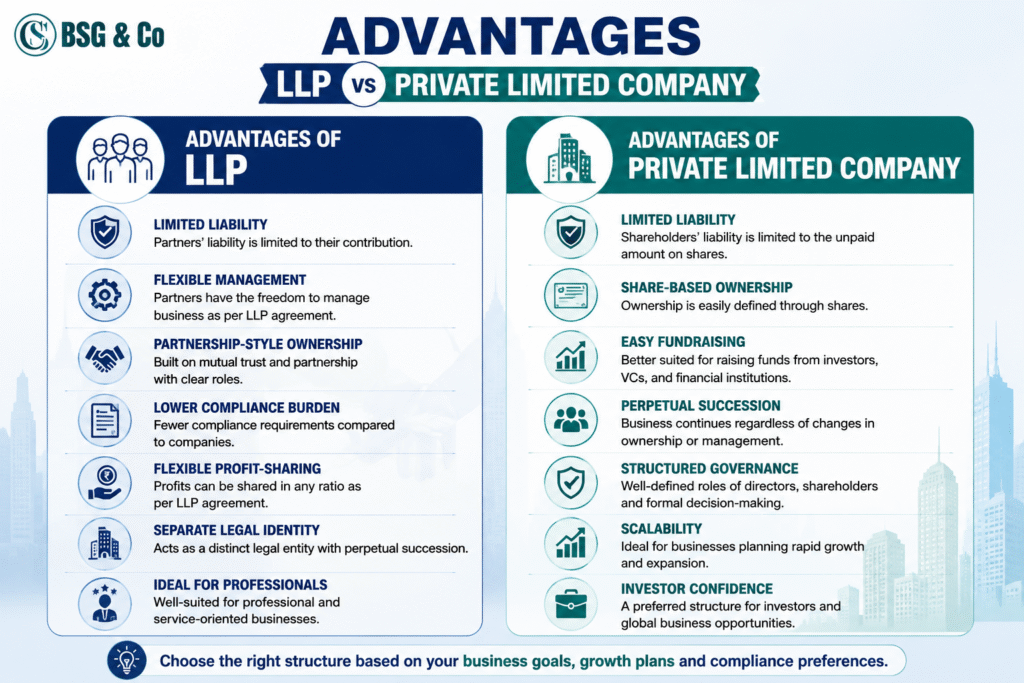
Advantages of an LLP
The major LLP benefits include:
- Limited liability protection
- Flexible management arrangements
- Partnership-style ownership
- Flexible profit-sharing
- Separate legal identity
- Potentially lighter compliance than a company
- Suitability for closely held and professional businesses
- No need to structure ownership entirely through shares
These features can make an LLP practical for businesses where the founders want flexibility and intend to remain closely involved in operations.
Advantages of a Private Limited Company
Private Limited Company benefits include:
- Limited liability protection
- Formal corporate governance
- Share-based ownership
- Better suitability for equity fundraising
- Easier structuring for multiple investors
- Perpetual succession
- Scalability for certain growth-oriented businesses
- Familiar structure for venture capital and angel investment
For businesses with ambitious expansion plans, the formal structure can make future ownership changes and investment arrangements easier to organise, subject to applicable legal requirements.
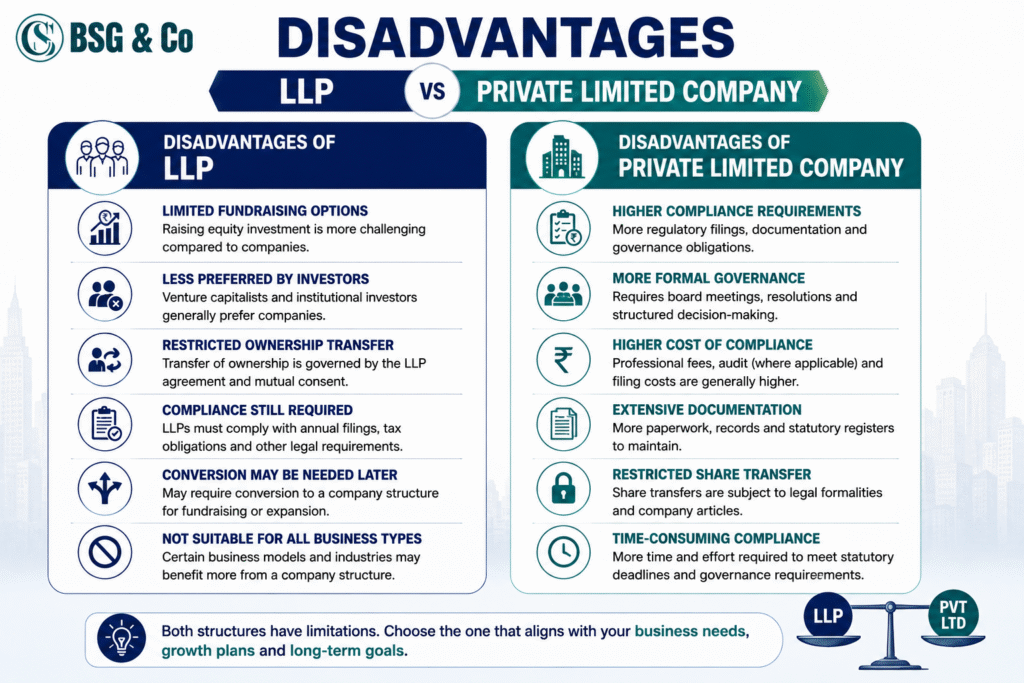
Disadvantages of an LLP
Despite its advantages, an LLP may not suit every business.
Potential limitations include:
- Conventional equity fundraising can be less straightforward
- Some venture capital investors may prefer a company structure
- Statutory compliance is still required
- Conversion or restructuring may become relevant as the business evolves
- Certain business models may benefit from share-based ownership
These limitations do not make an LLP unsuitable. They simply mean that the founders should consider their long-term objectives.
Disadvantages of a Private Limited Company
A company also has trade-offs.
Potential disadvantages include:
- Greater compliance requirements
- More formal governance
- Additional documentation
- Board-related responsibilities
- Statutory record-maintenance requirements
- Potentially higher recurring compliance costs
- Formalities surrounding share transfers and ownership changes
For a small partnership-oriented business with no immediate investment requirement, these additional formalities may not always provide sufficient practical benefit.
How to Choose Between an LLP and Private Limited Company?
A practical LLP vs Private Limited Company decision can begin with the following questions.
Choose an LLP when:
- Multiple active partners will operate the business
- Partnership-style ownership is preferred
- External equity investment is not an immediate objective
- Flexible internal management is important
- The business is professional or closely held
- The founders prefer a relatively flexible compliance framework
Consider a Private Limited Company when:
- External investors are expected
- Angel or venture capital funding is a possibility
- Equity-based ownership is important
- Rapid expansion is planned
- A formal governance structure is preferred
- Employee equity arrangements may become relevant
These are general considerations rather than universal rules. The LLP vs Private Limited Company decision should ultimately reflect the specific commercial and legal circumstances of the proposed business.
Can You Convert an LLP Into a Private Limited Company?
Businesses sometimes consider changing their legal structure when their objectives change. For example, an LLP may later require a corporate structure because of fundraising plans, new investors, expansion, or changes in ownership strategy.
The possibility and method of restructuring depend on the applicable law and the facts of the particular entity. Entrepreneurs should examine tax consequences, assets and liabilities, contracts, licenses, registrations, ownership, and regulatory requirements before proceeding.
A conversion should therefore not be treated as a simple administrative change. Professional and legal review can help identify potential implications before the restructuring is undertaken.
Common Mistakes When Choosing a Business Structure
Entrepreneurs frequently make structural decisions based only on immediate registration cost. This can create problems later.
Common mistakes include:
- Selecting a structure only because registration appears cheaper
- Ignoring future fundraising requirements
- Underestimating ongoing compliance
- Not understanding ownership implications
- Focusing on tax rates without considering the complete tax position
- Ignoring sector-specific requirements
- Failing to consider long-term expansion
- Assuming that changing the structure later will always be simple
A better approach is to prepare a basic three-to-five-year business plan and assess ownership, funding, taxation, compliance, and expansion requirements before registration.
Frequently Asked Questions
-
What is the difference between LLP and Private Limited Company?
The main difference is the ownership and governance model. An LLP is partnership-based, while a Private Limited Company is share-based and managed through directors. The LLP vs Private Limited Company comparison also involves differences in compliance, fundraising, and internal management.
-
Which is better, LLP or Private Limited Company?
Neither is universally better. The LLP vs Private Limited Company choice depends on funding plans, number of founders, ownership preferences, compliance expectations, and long-term growth.
-
Is LLP better than Private Limited Company for startups?
It depends on the startup’s objectives. An LLP may suit a founder-led or partnership-oriented venture, while a Private Limited Company may be more suitable where equity fundraising and rapid expansion are expected.
-
Which has more compliance, LLP or Private Limited Company?
Generally, a Private Limited Company has more formal ongoing compliance and governance requirements. However, the actual compliance burden depends on the entity’s activities, size, transactions, and applicable exemptions.
-
Can an LLP raise investment?
Yes. An LLP can receive partner contributions and may access other permissible forms of financing. However, its structure is generally less suited to conventional equity investment than a Private Limited Company.
-
Which structure is better for small businesses?
The LLP vs Private Limited Company decision for a small business depends on its ownership model and future plans. A closely held partnership-oriented business may find an LLP practical, while a business seeking investors may prefer a company.
-
Is a Private Limited Company more suitable for investors?
Often, yes, particularly for investors seeking equity ownership. Shares provide a familiar mechanism for allocating ownership and investment, although the suitability of a structure depends on the specific investment arrangement.
-
Can an LLP be converted into a Private Limited Company?
A business may explore restructuring or conversion where legally permitted and commercially appropriate. The applicable process and consequences depend on the circumstances and current legal requirements.
-
How should I choose between an LLP and Private Limited Company?
Start by evaluating your founders, ownership model, funding expectations, compliance capacity, tax position, sector requirements, and long-term growth strategy. A professional review can then help determine which structure best fits the business.
Conclusion
The LLP vs Private Limited Company question does not have one answer that applies to every entrepreneur.
An LLP can be attractive where flexibility, partnership-style ownership, and comparatively simpler compliance are important. A Private Limited Company can be more suitable where structured governance, share-based ownership, external equity investment, and scalability are priorities.
The right decision should consider the number of founders, business objectives, funding requirements, ownership preferences, compliance expectations, tax considerations, and long-term expansion plans.
Rather than choosing a structure solely because it is inexpensive or popular, entrepreneurs should select the structure that supports the business they intend to build.
Get Professional Guidance
BSG & Co offers professional guidance for entrepreneurs and businesses evaluating business structures, registration, and corporate compliance requirements.
Contact Details:
BSG & Co
Phone: +91-8660360492
Email: bhaskar@bhaskarbhatandco.in
Website: www.csfirmbsg.com
Address: 2nd Floor, 66, 13th Main Rd, 4th T Block East, 4th Block, Jayanagar, Bengaluru, Karnataka 560011
Before selecting a legal structure, entrepreneurs should consider their specific circumstances and obtain appropriate professional guidance where necessary.