
Practicing Company Secretary in India: Roles, Responsibilities, Services and Importance for Businesses
Introduction – Why Businesses Need a Practicing Company Secretary
Running a business in India involves more than developing products, serving customers and generating revenue. Every registered company must follow applicable corporate laws, maintain statutory records and complete regulatory filings within prescribed timelines. As businesses grow, these responsibilities become more detailed and require professional attention.
The Companies Act, 2013, and the rules introduced under it establish various obligations for companies, directors and management teams. Missing a filing deadline, maintaining incorrect records or overlooking statutory requirements can lead to additional costs and legal complications.
This is where a Practicing Company Secretary becomes valuable. A qualified professional helps businesses understand corporate law requirements, manage MCA compliance, prepare statutory documentation and improve corporate governance.
For startups, private limited companies, public companies and established businesses, engaging a professional Company Secretary can make corporate compliance more organised. This article explains the qualifications, responsibilities, services and importance of a Company Secretary in Practice in India.
Who Is a Practicing Company Secretary?
A Practicing Company Secretary (PCS), also known as a Company Secretary in Practice, is a qualified member of the Institute of Company Secretaries of India (ICSI) who holds a valid Certificate of Practice (CoP).
ICSI is a statutory professional body established under the Company Secretaries Act, 1980, and functions under the administrative jurisdiction of the Ministry of Corporate Affairs.
A member must obtain a Certificate of Practice from ICSI before undertaking independent professional practice as a Company Secretary.
The professional may provide permitted services relating to:
- Company formation and incorporation.
- Corporate law and statutory compliance.
- MCA and ROC filings.
- Corporate governance.
- Secretarial audits, where authorised and applicable.
- Corporate restructuring and documentation.
- Professional certification within the scope of applicable laws.
Difference between an employed and practising professional: An employed Company Secretary generally works within an organisation and handles its internal secretarial and compliance responsibilities. A practising professional independently provides permitted professional services to clients.
A Certificate of Practice also carries professional obligations relating to independence, competence, confidentiality and ethical conduct.
Qualifications Required to Become a Practicing Company Secretary in India
Becoming a Company Secretary requires professional education, examinations and prescribed practical training.
The general professional journey includes:
- Register with ICSI: Enrol in the Company Secretary course and follow the applicable entry requirements.
- Complete the prescribed examinations: Pass the relevant professional programme examinations.
- Complete practical training: Fulfil the training requirements prescribed under ICSI regulations.
- Obtain ICSI membership: Apply for admission as an Associate Member (ACS) after satisfying the requirements. Eligible members may subsequently become Fellows (FCS).
- Apply for Certificate of Practice: Obtain the required CoP from ICSI before commencing independent practice.
- Maintain professional requirements: Pay applicable membership and practice fees, fulfil continuing professional development requirements and follow professional regulations.
A member holding only ICSI membership should not automatically describe themselves as being authorised to practise independently. The Certificate of Practice is an essential requirement.
ICSI also prescribes a PCS Orientation Programme for members entering practice, subject to applicable exemptions.
Difference Between a Company Secretary and a Practicing Company Secretary
Both professionals possess Company Secretary qualifications, but their employment arrangements and professional responsibilities differ.
| Particulars | Employed Company Secretary | Practising Company Secretary |
| Employment | Works for an organisation | Independent professional practice |
| Certificate of Practice | Not required for ordinary employment | Required for practice |
| Main role | Internal corporate compliance | Professional services for clients |
| Responsibilities | Organisation-specific | Across permitted client engagements |
| Engagement | Employment relationship | Professional engagement |
| Professional obligations | ICSI professional requirements | ICSI practice and ethical requirements |
An employed professional focuses primarily on the organisation’s internal legal and compliance needs. A practising professional works with different businesses and provides independent advice and services within the permitted scope.
Roles and Responsibilities of a Practicing Company Secretary
The responsibilities of a Company Secretary in Practice extend beyond submitting forms to government departments. They involve helping businesses understand legal obligations, maintain corporate records and follow appropriate governance practices.

Corporate Law Compliance
A professional assists companies in understanding their obligations under the Companies Act, 2013, applicable rules and other relevant regulations.
This includes reviewing compliance requirements, identifying pending filings, advising on statutory procedures and helping directors understand their responsibilities.
ROC and MCA Filings
Companies must submit various documents and statutory returns to the Registrar of Companies (ROC) through the Ministry of Corporate Affairs (MCA) portal.
A practising professional can assist with:
- Annual returns and financial statement filing.
- Director-related forms.
- Changes in registered office details.
- Share capital-related filings.
- Event-based statutory filings.
- Other applicable MCA submissions.
Company Incorporation and Registration
A Practicing Company Secretary can assist entrepreneurs with selecting a suitable business structure, preparing incorporation documents and completing applicable registration formalities.
This may include Private Limited Companies, One Person Companies, public companies and LLPs, subject to the relevant legal procedures.
Corporate Governance
Corporate governance refers to the systems and procedures through which a business is managed and controlled.
Professional assistance may include:
- Preparing board meeting documentation.
- Supporting shareholder meeting procedures.
- Drafting resolutions and minutes.
- Maintaining statutory registers.
- Advising on directors’ duties.
- Supporting transparent decision-making.
Secretarial Audit
Secretarial audit involves examining a company’s compliance with applicable corporate and other relevant laws.
Under Section 204 of the Companies Act, 2013, specified companies must obtain a secretarial audit report from a Company Secretary in Practice.
The audit helps identify compliance gaps, procedural irregularities and areas requiring corrective action.
Legal and Regulatory Documentation
A professional can assist with preparing and reviewing corporate documents, including:
- Board and shareholder resolutions.
- Meeting notices and minutes.
- Statutory registers.
- Share allotment and transfer documentation.
- Corporate declarations.
- Applicable agreements and compliance records.
The nature of the engagement determines whether additional legal or professional specialists are required.
Services Offered by a Practicing Company Secretary
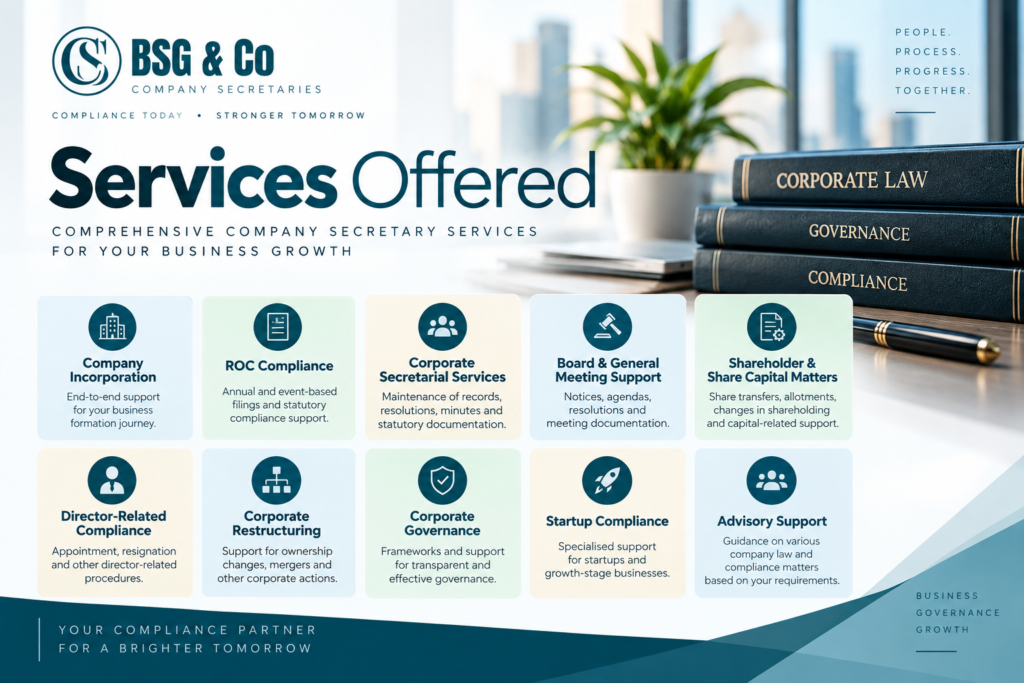
Businesses require different services depending on their size, structure and stage of development. Some of the important Company Secretary services include:
- Company incorporation: Assistance with company formation and registration.
- LLP registration: Documentation and filing assistance for Limited Liability Partnerships.
- Startup registration: Guidance on business incorporation and eligible DPIIT recognition applications.
- Annual ROC compliance: Preparation and filing assistance for applicable annual returns and financial statements.
- MCA documentation: Preparation and submission of relevant electronic forms.
- Director-related compliance: Assistance with DIN-related requirements, director KYC, appointments and resignations.
- Share allotment and transfer: Documentation and statutory filing support for ownership changes.
- Increase in authorised capital: Assistance with applicable resolutions, documentation and MCA filings.
- Registered office changes: Guidance on statutory procedures for changing the registered office.
- MOA and AOA alterations: Assistance with changes to constitutional documents.
- Secretarial audit: Conducting audits where the professional is authorised and the company falls within the applicable requirements.
- Corporate restructuring: Professional assistance with permitted restructuring and reorganisation matters.
- Due diligence: Reviewing corporate records and identifying potential compliance issues.
- Governance support: Assistance with board procedures and corporate governance documentation.
- Compliance reviews: Reviewing statutory obligations and highlighting pending requirements.
It is important to understand that not every service involves the same professional authority. Certain certifications, audits and transactions have specific statutory eligibility conditions. Services such as financial statement audits, tax audits and legal representation in reserved areas may require other appropriately qualified professionals.
Why Is a Practicing Company Secretary Important for Private Limited Companies?
A Private Limited Company has ongoing statutory responsibilities after receiving its Certificate of Incorporation. Directors must ensure that the organisation follows the applicable legal requirements throughout its operations.
Annual compliance for private limited companies commonly involves:
- Filing financial statements with the ROC.
- Filing annual returns.
- Completing applicable director KYC requirements.
- Maintaining statutory registers.
- Conducting board meetings as required.
- Holding annual general meetings, where applicable.
- Recording board and shareholder resolutions.
- Maintaining shareholding and allotment records.
- Completing event-based filings within prescribed timelines.
For example, a company issuing new shares to an investor must follow the applicable provisions relating to share issuance, approvals, documentation and filing.
A professional Practicing Company Secretary can help directors understand these procedures and coordinate the necessary documentation.
The requirement to appoint a whole-time Company Secretary also depends on statutory thresholds and company classification. For example, Rule 8A of the Companies (Appointment and Remuneration of Managerial Personnel) Rules, 2014, requires every private company with paid-up share capital of ₹10 crore or more to appoint a whole-time Company Secretary.
When Should a Startup or Business Hire a Practicing Company Secretary?
Professional assistance is useful at different stages of a business. Entrepreneurs should consider engaging a professional when:
- Starting a new company or LLP.
- Choosing a suitable business structure.
- Preparing incorporation documentation.
- Appointing or changing directors.
- Issuing or transferring shares.
- Bringing new investors into the business.
- Changing company ownership.
- Expanding business operations.
- Completing pending ROC filings.
- Undertaking corporate restructuring.
- Preparing for a statutory secretarial audit.
- Reviewing existing corporate compliance.
A Practicing Company Secretary can also help founders understand their responsibilities before entering into important corporate transactions.
Benefits of Hiring a Practicing Company Secretary
Engaging a qualified professional provides several practical advantages.
- Professional compliance guidance: Understand applicable corporate laws and filing requirements.
- Better corporate governance: Maintain organised board procedures and shareholder documentation.
- Accurate documentation: Prepare resolutions, minutes, registers and other statutory records correctly.
- Regulatory filing assistance: Get support with relevant MCA and ROC submissions.
- Reduced procedural errors: Professional review can help identify documentation and filing mistakes.
- Director awareness: Understand legal responsibilities and applicable statutory obligations.
- Business expansion support: Obtain guidance when changing ownership, issuing shares or restructuring the organisation.
- Improved record management: Maintain accessible and organised corporate documents.
- Deadline management: Track applicable filing dates and compliance requirements.
Professional engagement does not transfer the directors’ statutory responsibilities to the service provider or guarantee that penalties will never arise. It provides informed assistance in managing applicable obligations.
Practicing Company Secretary and Corporate Compliance in India
Corporate compliance in India is governed by several laws, rules and professional standards. The applicable requirements depend on the company’s legal structure, size, activities and regulatory classification.
Some important regulatory frameworks include:
- Companies Act, 2013: Governs company incorporation, management, directors, shareholder rights and statutory filings.
- Companies (Appointment and Remuneration of Managerial Personnel) Rules, 2014: Covers applicable requirements relating to managerial personnel and Company Secretary appointments.
- ICSI Secretarial Standards: SS-1 covers board meetings and SS-2 covers general meetings. The revised standards became effective from 1 April 2024.
- LLP Act, 2008: Governs the incorporation, management and compliance of Limited Liability Partnerships.
- SEBI regulations: Apply to listed companies and other regulated entities according to their classification and activities.
Section 205 of the Companies Act, 2013, also describes the functions of a Company Secretary, including reporting to the Board on compliance and ensuring adherence to applicable secretarial standards.
A professional can help businesses interpret and manage these requirements, but the exact compliance calendar must be prepared according to the individual entity’s circumstances.
How to Choose the Right Practicing Company Secretary in Bangalore?
Choosing the right professional is important because corporate compliance involves confidential documents, financial information and statutory responsibilities.
Consider these factors before engaging a professional:
- Valid ICSI membership: Verify professional membership details.
- Certificate of Practice: Confirm that the professional holds a valid CoP.
- Relevant experience: Look for experience in company incorporation, ROC filings and corporate compliance.
- Legal knowledge: Ensure familiarity with the Companies Act, 2013, and applicable rules.
- MCA experience: Check familiarity with electronic filing procedures.
- Professional communication: Choose someone who explains requirements clearly.
- Transparent fees: Understand the professional scope, government fees and additional charges.
- Timely support: Discuss how filing deadlines and compliance reminders will be managed.
- Confidentiality: Ensure proper handling of sensitive business documents.
Before appointing a professional, businesses can also verify membership and practice details through the ICSI member directory.
Why Choose BSG & CO – Company Secretary Firm in Bangalore?
Businesses need appropriate professional support to manage incorporation procedures, corporate documentation and ongoing statutory obligations.
BSG & CO is a professional Company Secretary firm based in Bangalore, India, offering corporate registration and compliance-related assistance to entrepreneurs, startups and established businesses.
The firm’s relevant service areas include:
- Company registration and incorporation assistance.
- LLP registration.
- Startup registration guidance.
- ROC and MCA compliance.
- Annual filing support.
- Corporate documentation.
- Director-related compliance.
- Corporate governance assistance.
- Secretarial compliance support.
- Business registration and compliance guidance.
Whether you are establishing your first company or managing an existing organisation, professional guidance can help you understand applicable corporate requirements and plan the necessary filings.
Businesses looking for a Company Secretary firm in Bangalore can consult BSG & CO to discuss their incorporation, documentation and compliance requirements.
Contact BSG & Co
Phone: +91-8660360492
Email: bhaskar@bhaskarbhatandco.in
Website: www.csfirmbsg.com
Address: 2nd Floor, 66, 13th Main Rd, 4th T Block East, 4th Block, Jayanagar, Bengaluru, Karnataka 560011

Frequently Asked Questions About Practicing Company Secretaries
-
Who is a Practicing Company Secretary in India?
A Practicing Company Secretary is an ICSI member holding a valid Certificate of Practice who provides permitted professional services independently. These services include corporate compliance, company incorporation, ROC filings and secretarial audits, where applicable.
-
What is the difference between a Company Secretary and a Practicing Company Secretary?
An employed Company Secretary works within an organisation and handles its internal compliance responsibilities. A practising professional independently provides permitted corporate secretarial services to clients.
-
What is a Certificate of Practice?
A Certificate of Practice is issued by ICSI to eligible members who wish to practise the profession independently. It authorises the member to undertake professional practice subject to applicable regulations.
-
Can a Practicing Company Secretary register a Private Limited Company?
Yes. A qualified professional can assist with Private Limited Company incorporation, including name reservation, documentation, preparation of incorporation forms and MCA filing procedures.
-
Can a Practicing Company Secretary handle ROC filings?
Yes. A professional holding a valid CoP can undertake permitted ROC and MCA filing-related services, including preparation, submission and applicable certification of statutory documents.
-
Is a Practicing Company Secretary required for every Private Limited Company?
No. Every Private Limited Company does not need to appoint an external practising professional. However, certain companies must appoint a whole-time Company Secretary based on applicable statutory requirements.
-
What services can a Practicing Company Secretary provide?
Services include company incorporation, LLP registration, annual compliance, MCA filings, director-related documentation, corporate governance, secretarial audits and permitted corporate advisory services.
-
How do I find a Practicing Company Secretary in Bangalore?
You can search the ICSI member directory, verify the professional’s membership and Certificate of Practice, review their experience and consult a suitable Company Secretary firm in Bangalore.
-
Can a Practicing Company Secretary conduct a secretarial audit?
Yes. A Company Secretary in Practice can conduct a secretarial audit under Section 204 of the Companies Act, 2013, for companies covered by the applicable statutory provisions.
-
What is the role of a Practicing Company Secretary in startup compliance?
A professional helps startups choose appropriate business structures, complete incorporation procedures, maintain statutory records, manage ROC filings and understand DPIIT recognition requirements.
Conclusion – Get Professional Corporate Compliance Support from BSG & CO
Corporate compliance is an important responsibility for every registered business in India. From incorporation and statutory documentation to annual filings and corporate governance, companies must understand and fulfil their applicable legal obligations.
Engaging a qualified Practicing Company Secretary helps businesses manage these responsibilities with professional guidance. It also supports better documentation, informed decision-making and organised corporate administration.
Whether you are a startup founder, entrepreneur, director or established business owner, choosing the right professional support can make corporate compliance easier to manage.
BSG & CO, Company Secretary Firm in Bangalore, provides assistance with company incorporation, LLP registration, ROC filings, startup compliance and corporate secretarial services.
Contact BSG & CO to discuss your business registration and corporate compliance requirements and get professional guidance for your organisation.
Official references for further reading:
- ICSI – Membership and Certificate of Practice
- ICSI – Practising Company Secretary
- Companies Act, 2013 – India Code
- ICSI – Revised Secretarial Standards