
Startup Registration in Bangalore: A Complete Guide for New Entrepreneurs
Starting a new business in Bangalore can be exciting, but turning a business idea into a legally structured venture requires more than simply choosing a name and starting operations. Startup registration helps entrepreneurs establish the appropriate legal structure, meet applicable regulatory requirements, and create a stronger foundation for future growth.
Bangalore is one of India’s leading startup and technology hubs, with businesses ranging from technology companies and consulting firms to e-commerce ventures, manufacturing businesses, professional services, and innovative product companies. For founders planning startup registration in Bangalore, one of the first decisions is choosing the right business structure based on ownership, liability, funding requirements, taxation, and long-term objectives.
It is also important to understand that registering a business and obtaining recognition under the Startup India initiative are not necessarily the same thing. The correct approach depends on the nature and requirements of the proposed venture.
What Is Startup Registration?
Startup registration refers broadly to the process of legally establishing a new business under an appropriate structure and completing the registrations applicable to that entity and its activities.
There is no single business structure called a “startup.” A founder may establish a startup as a Private Limited Company, Limited Liability Partnership (LLP), registered partnership firm, or another suitable structure depending on the circumstances.
For example, a founder planning to raise venture capital and issue shares may consider a Private Limited Company. A professional venture with two or more partners may consider an LLP. A smaller business with a straightforward ownership model may have different requirements.
Therefore, startup registration should begin with an assessment of:
- Number of founders
- Ownership and proposed shareholding
- Funding requirements
- Liability protection
- Tax considerations
- Business activities
- Plans for expansion
- Compliance responsibilities
- Potential investor requirements
Choosing the right structure at the beginning can help avoid unnecessary restructuring later.

Why Is Startup Registration Important?
Proper startup company registration gives a business a formal legal and operational framework. Depending on the structure selected, important advantages can include:
Legal recognition
A registered company, LLP, or partnership has a formal legal identity or registration status under the applicable law. This can make it easier to conduct business with customers, suppliers, institutions, and other organizations.
Limited liability protection
Structures such as Private Limited Companies and LLPs can provide limited liability protection, subject to applicable laws and circumstances. This can help separate business liabilities from the personal liabilities of founders.
Better business credibility
Customers, vendors, banks, investors, and potential business partners may prefer dealing with a formally established entity.
Business banking
A formally registered entity can generally establish a business bank account after completing the required documentation and banking formalities.
Access to funding
A suitable corporate structure can make it easier to structure investments, shareholding, and other funding arrangements. Private Limited Companies are commonly preferred for equity investment by investors.
Contracts and partnerships
A registered business can enter into commercial contracts, vendor agreements, service agreements, employment arrangements, and partnerships in its legal name.
Compliance and expansion
Proper registration creates a framework for managing applicable tax, accounting, corporate, labour, and industry-specific requirements as the business grows.
Types of Business Structures for Startups in India
Before beginning the startup registration process, founders should understand the major business structures available.
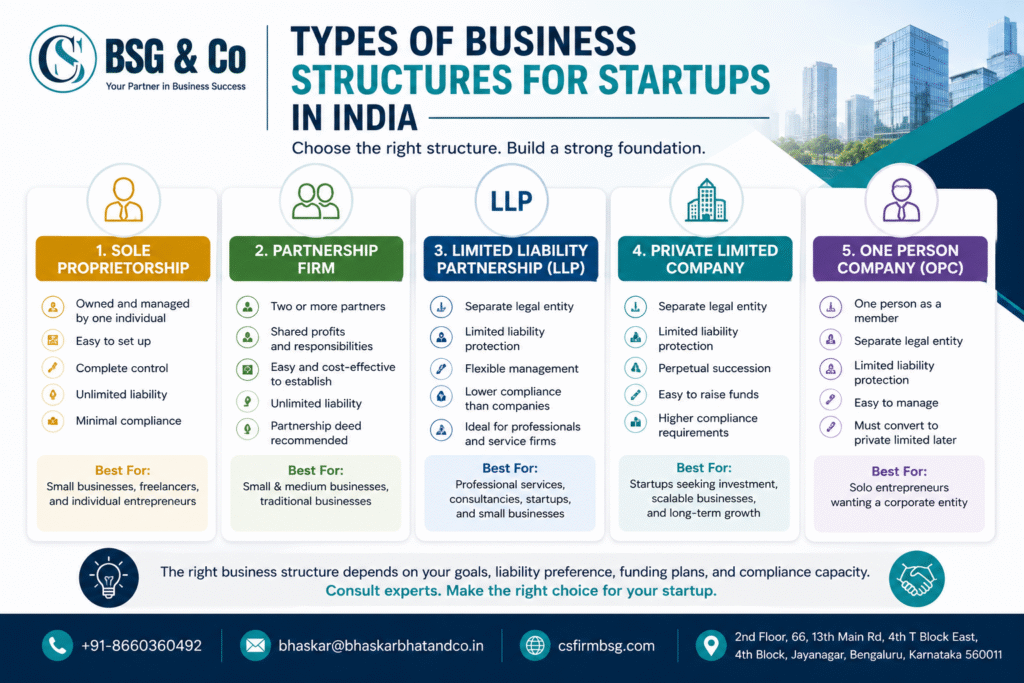
Sole Proprietorship
A sole proprietorship is owned and operated by one individual. It can be relatively simple to operate, but it does not create a separate legal entity distinct from the proprietor.
It may be suitable for certain small businesses, but founders seeking formal startup recognition, outside equity investment, or a scalable corporate structure may need to consider alternatives.
Partnership Firm
A partnership firm can be established by two or more individuals under the applicable partnership law. Partners generally share responsibility for managing the business according to the partnership agreement.
A registered partnership can be considered for certain traditional and professional businesses, although founders should carefully understand liability and compliance implications.
Limited Liability Partnership (LLP)
An LLP combines features of a partnership with limited liability protection for its partners, subject to applicable law.
It can be useful for professional businesses, service ventures, and founders who want a flexible structure without adopting the full corporate framework of a Private Limited Company.
Private Limited Company
A Private Limited Company is one of the most commonly considered structures for scalable startups.
It provides a separate corporate identity and a framework for shareholding and investment. It is often considered by founders planning to raise external equity, build an investor-backed company, or expand operations significantly.
However, it also comes with ongoing statutory and financial compliance obligations.
One Person Company (OPC)
An OPC allows a single individual to establish a corporate entity, subject to the requirements of the Companies Act and applicable rules.
It may be considered by an individual founder who wants a corporate structure while initially operating alone. The suitability of an OPC depends on the founder’s long-term plans and applicable regulatory requirements.
Startup Registration Process in India
The exact procedure depends on the entity selected. A general overview of startup registration in Bangalore may include the following steps.
1. Choose the appropriate business structure
Start by evaluating whether a proprietorship, partnership, LLP, Private Limited Company, OPC, or another structure is appropriate.
2. Select and verify the business name
Founders should choose a name that complies with the applicable naming rules and does not create conflicts with existing entities or trademarks.
3. Obtain Digital Signature Certificates
Digital signatures may be required for filing electronic applications with government authorities, depending on the entity and filing requirements.
4. Prepare the required documents
Identity documents, address proof, registered office documents, declarations, incorporation documents, and other supporting information may be required.
5. Complete incorporation or registration formalities
For companies, incorporation is completed through the applicable Ministry of Corporate Affairs process. LLPs and partnership firms follow their respective registration procedures.
6. Obtain the relevant registration certificate
Once the applicable authority approves the application, the entity receives the relevant incorporation or registration documentation.
7. Apply for PAN and TAN where applicable
PAN and, where required, TAN form part of the tax and financial framework of the business.
8. Open a business bank account
After obtaining the necessary entity documents, founders can approach a bank to establish a current account in the business’s name.
9. Complete applicable tax registrations
GST registration, professional tax, and other registrations may apply depending on the business’s activities, turnover, location, employees, and statutory requirements.
10. Understand ongoing startup compliance
Registration is not the end of the process. Businesses may have continuing requirements involving accounting, tax filings, annual returns, statutory records, payroll, licences, and other regulatory obligations.
Not every startup requires every registration. Requirements should be assessed according to the entity and business activity.
Documents Required for Startup Registration
The documents required for startup registration vary according to the entity type and individual circumstances.
Common documents may include:
- PAN and identity proof of founders or partners
- Address proof
- Passport-size photographs where applicable
- Registered office address proof
- Rental agreement or ownership documents, where applicable
- Recent utility bill
- Digital Signature Certificate, where required
- Incorporation or constitutional documents
- Partnership deed or LLP agreement, where applicable
- Authorisation or declarations where required
- Additional documents requested by the relevant authority
Founders should ensure that names, addresses, signatures, and supporting documents are consistent across the application. Incorrect or incomplete information can lead to queries or delays.
How Long Does Startup Registration Take?
The timeline for startup registration depends on the entity type, completeness of documentation, government processing, name-related issues, professional review, and whether additional clarification is requested.
A straightforward application with accurate documents may move through the process more efficiently than an application requiring corrections or additional submissions.
Therefore, entrepreneurs should avoid relying on unrealistic guaranteed timelines. A professional can help identify documentation issues before submission, but final processing depends on the relevant authorities and circumstances.
Startup Registration Cost in Bangalore
There is no single fixed price for startup registration Bangalore because the total cost depends on the entity structure and services required.
The overall expense may include:
- Government filing fees
- Applicable stamp duty
- Digital Signature Certificate costs
- Professional fees
- Applicable tax registrations
- Documentation expenses
- Other statutory registrations
- Post-registration compliance services
For this reason, entrepreneurs should request a clear quotation based on their proposed business structure and requirements rather than relying only on advertised starting prices.
Government fees and regulatory charges can change, so current charges should be confirmed before filing.
Startup Registration vs Startup India Recognition
One of the most important points for new founders is understanding the difference between business registration and Startup India recognition.
Business registration or incorporation establishes the legal structure of the business. Startup India recognition is a separate recognition process administered under the Startup India initiative by the Department for Promotion of Industry and Internal Trade (DPIIT).
Current Startup India information states that eligible entities can include Private Limited Companies, registered partnership firms, LLPs, and eligible cooperative societies. For a normal startup, the current criteria include an age limit of up to 10 years and turnover not exceeding ₹200 crore in any financial year since incorporation or registration, along with innovation, improvement, or a scalable business model with potential for employment or wealth creation. DeepTech startups have separate criteria, including a higher age and turnover threshold.
DPIIT recognition may provide access to certain benefits and initiatives, but recognition is not automatically granted merely because a business has been registered.
The Startup India portal also states that DPIIT recognition applications are made through the National Single Window System and that the government does not charge a fee for the DPIIT Certificate of Recognition.
Founders should therefore treat these as two related but distinct processes:
Business registration → Establish the business entity
DPIIT recognition → Apply separately if the eligible business meets Startup India criteria
Common Mistakes to Avoid During Startup Registration
First-time founders can make avoidable mistakes during business registration. Some common issues include:
Choosing the wrong structure
Selecting an entity only because it appears inexpensive can create problems when the business later seeks investment, adds partners, or expands.
Incorrect documentation
Mismatched names, addresses, signatures, or incomplete documents can result in queries and additional work.
Ignoring name considerations
A business name should be checked carefully for legal and trademark-related conflicts before significant branding expenses are incurred.
Failing to understand registered office requirements
The registered office must meet the applicable requirements, and appropriate address proof may be required.
Ignoring ongoing compliance
A business does not become fully compliant simply because it has received an incorporation certificate. Annual filings, tax filings, accounting, statutory records, and other requirements may continue.
Delaying applicable registrations
Depending on the business, GST, professional tax, Shops and Establishments requirements, labour registrations, FSSAI, licences, or sector-specific approvals may apply.
Choosing professional services only on price
The lowest quoted fee does not necessarily represent the best overall value. Founders should consider the scope of work, documentation support, communication, and post-registration assistance.
Why Choose a Startup Registration Consultant in Bangalore?
A startup registration consultant in Bangalore can help founders understand the different entity options and identify the registrations relevant to their proposed business.
Professional assistance can be useful for:
- Comparing business structures
- Understanding incorporation requirements
- Preparing documentation
- Filing applicable applications
- Addressing government queries
- Understanding PAN and TAN requirements
- Identifying applicable tax registrations
- Understanding post-registration compliance
- Planning the next steps after incorporation
The role of a professional is to guide the entrepreneur through the applicable process rather than promise guaranteed approval or government benefits.
For founders unfamiliar with company incorporation in Bangalore, getting professional advice before submitting applications can help reduce avoidable errors.
Why Choose Bhaskar Bhat & Co. for Startup Registration in Bangalore?
Choosing the right professional guidance can make the registration process easier to understand, particularly for first-time entrepreneurs.
Bhaskar Bhat & Co. assists entrepreneurs and businesses with professional guidance relating to startup registration, business registration, company incorporation, and applicable compliance requirements.
If you are planning to register a startup in India and are based in Bangalore, you can discuss your proposed business structure, founder requirements, documentation, and registration needs with the team before proceeding.
Contact Bhaskar Bhat & Co.
Bhaskar Bhat & Co.
2nd Floor, 66, 13th Main Rd, 4th T Block East, 4th Block, Jayanagar, Bengaluru, Karnataka 560011
Phone: +91-8660360492
Email: bhaskar@bhaskarbhatandco.in
Website: csfirmbsg.com
Entrepreneurs can contact the firm to discuss their specific startup registration requirements and understand which registrations and compliance obligations may apply to their business.
Frequently Asked Questions About Startup Registration
1. What is startup registration?
Startup registration generally refers to establishing a business under an appropriate legal structure and completing the registrations applicable to that business. The exact process depends on whether the entrepreneur chooses a company, LLP, partnership, or another structure.
2. How do I register a startup in Bangalore?
First, select the appropriate business structure and business name. Then prepare the required documents, obtain applicable digital signatures, complete the relevant incorporation or registration filings, obtain the registration certificate, and complete applicable tax and business registrations.
3. What documents are required for startup registration?
Common documents include PAN, identity and address proof of founders, registered office proof, utility bills, digital signatures where required, and constitutional or incorporation documents. Requirements vary according to the entity type.
4. How much does startup registration cost in Bangalore?
The cost depends on the business structure, government fees, stamp duty, professional charges, digital signature costs, and additional registrations. A current quotation should be obtained based on the specific requirements of the proposed business.
5. How long does startup registration take?
The processing period can vary depending on the entity, document accuracy, name approval, government processing, and whether additional information is requested. It is better to treat published timelines as indicative rather than guaranteed.
6. Which business structure is best for a startup?
There is no universally best structure. A Private Limited Company may be suitable for a venture expecting equity investment, while an LLP or partnership may suit different business models. The decision should consider ownership, liability, funding, compliance, and future plans.
7. Is Startup India recognition the same as company registration?
No. Company or business registration establishes the legal entity, while DPIIT Startup India recognition is a separate process for eligible entities. Meeting the eligibility criteria is necessary before applying for recognition.
Conclusion
Starting a business in Bangalore requires more than an idea and a business name. Proper startup registration provides the legal and operational foundation from which entrepreneurs can build their ventures. Selecting an appropriate structure, preparing accurate documents, completing applicable registrations, and understanding ongoing startup compliance can help founders avoid unnecessary complications as the business grows.
Entrepreneurs should also remember that business incorporation and Startup India recognition are separate concepts. An eligible business may explore DPIIT recognition after establishing the appropriate entity and meeting the applicable criteria.
If you are planning startup registration in Bangalore, professional guidance can help you understand the available structures, documentation, registration process, and compliance requirements relevant to your business.
For assistance with your startup registration requirements, contact Bhaskar Bhat & Co., Jayanagar, Bengaluru, at +91-8660360492 or bhaskar@bhaskarbhatandco.in to discuss your requirements.