
Introduction
Building a successful business requires more than offering quality products or services. A business also needs a unique identity that customers can recognise, remember and trust. Your business name, logo, tagline, product name and brand identity help distinguish your business from competitors. Protecting these elements is an important part of long-term business growth. This is where a trademark becomes essential.
Whether you are starting a new company, running a small business, managing an established organisation or launching a new product, trademark protection can help secure your brand identity. In India, trademark registration is governed by the Trade Marks Act, 1999, and the Trade Marks Rules, 2017.
A registered trademark provides legal rights over the registered mark in connection with the specified goods or services. It also helps businesses prevent unauthorised use of identical or confusingly similar marks and build a valuable intellectual property asset.
For startups, entrepreneurs, manufacturers, service providers and growing companies, understanding the trademark registration process is an important step towards protecting business interests.
In this guide, BSG & CO, Company Secretary Firm in Bangalore, explains everything you need to know about trademark registration in India, including its meaning, types, benefits, eligibility, documents, registration procedure, government fees, validity and renewal.
What Is a Trademark?
A trademark is a unique sign, name, symbol, word, logo, design or combination of elements that identifies the goods or services of one business and distinguishes them from those of other businesses.
In simple terms, a trademark helps customers identify the source of a product or service. For example, when customers see a familiar company name or logo on a product, they can recognise the brand and associate it with their previous experience.
A trademark may include:
- Business or company names
- Brand names and product names
- Logos and symbols
- Taglines and slogans
- Letters and numbers
- Distinctive packaging and product shapes
- Certain colour combinations
- Distinctive sounds capable of representation
For example, a clothing company may register its brand name, while a technology company may protect its logo and product name. Similarly, a consultancy firm can apply to register its service brand.
Trademark registration is not limited to large corporations. Individuals, startups, small businesses, partnership firms and other eligible entities can also apply.
Why Is Trademark Registration Important for Businesses?
Many entrepreneurs invest significant time and money in developing their business names, logos, websites, packaging and marketing campaigns. However, some businesses begin using a brand without checking whether another person has already registered or applied for a similar mark.
This can create legal complications, including objections, infringement disputes and the possibility of changing an established brand identity.
Trademark registration helps reduce these risks by providing statutory protection to the registered proprietor.

Here are some important reasons why businesses should consider trademark registration:
-
Protects Your Brand Identity
A registered trademark helps protect your business name, logo or other distinctive brand elements against unauthorised use in relation to the registered goods or services.
-
Builds Customer Recognition
Customers often choose brands they recognise and trust. A distinctive trademark helps create a consistent identity across advertisements, websites, products and customer communications.
-
Provides Legal Rights
Registration provides the proprietor with statutory rights and legal remedies against infringement, subject to the applicable law and the scope of registration.
-
Creates an Intangible Business Asset
A trademark can become a valuable intellectual property asset. It may be licensed, assigned or commercially exploited in accordance with applicable legal requirements.
-
Supports Business Expansion
If you plan to expand into new cities, introduce additional products or establish franchise operations, protecting your brand becomes increasingly important.
-
Helps Prevent Brand Misuse
Trademark registration can help businesses take appropriate legal action when others use identical or deceptively similar marks in circumstances that amount to infringement.
Different Types of Trademarks in India
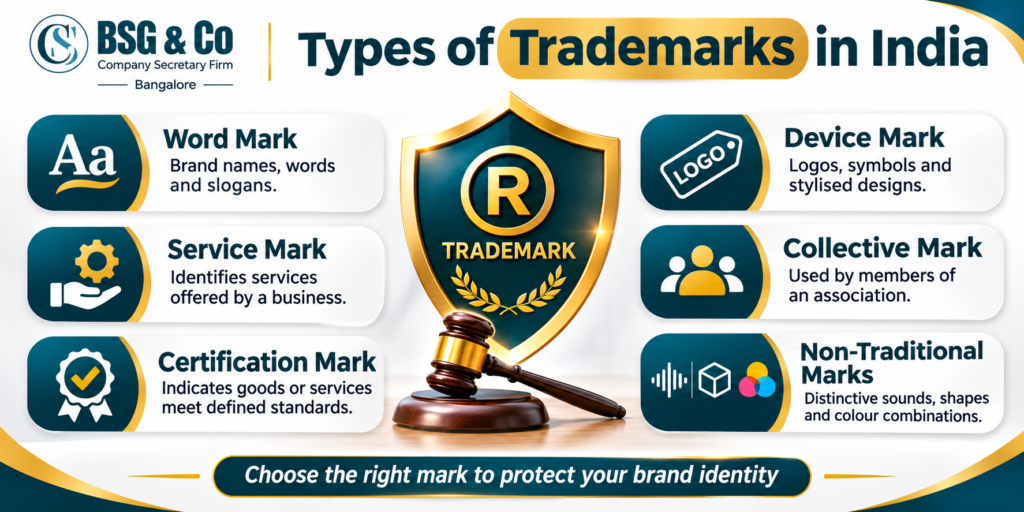
Businesses can protect different elements of their identity through trademark registration. The appropriate type depends on the brand element they want to protect.
-
Word Mark
A word mark protects a distinctive word, name, letter or combination of characters, subject to legal requirements.
For example, a business may apply to register its brand name independently of its logo design.
A word mark is particularly useful when a company wants protection for its brand name across different visual presentations.
-
Logo or Device Mark
A logo or device mark protects a distinctive graphical representation, symbol or stylised brand design.
For example, businesses that use a specially designed logo on their products, visiting cards, websites and advertisements may consider registering the logo.
-
Service Mark
A service mark identifies and distinguishes services rather than physical products.
For example, businesses operating in consulting, education, hospitality, financial services and digital marketing may use trademarks to protect their service brands.
-
Collective Trademark
A collective trademark is used by members of an association or organisation to identify their membership or distinguish their goods or services in accordance with the applicable regulations.
-
Certification Trademark
A certification trademark indicates that particular goods or services meet specified standards relating to quality, origin, material or other characteristics.
-
Shape and Packaging Marks
A distinctive product shape or packaging design may qualify for trademark protection if it satisfies the applicable legal conditions.
-
Sound and Colour Marks
Certain distinctive sounds and colour combinations may also be registered as trademarks when they meet the statutory requirements.
Choosing the right trademark category and representation is important because the nature of the application affects the protection being sought.
Who Can Apply for Trademark Registration in India?
Trademark registration in India is available to different types of applicants. You do not need to establish a private limited company before applying for a trademark.
Eligible applicants include:
- Individuals and sole proprietors
- Private Limited Companies
- Public Limited Companies
- Limited Liability Partnerships (LLPs)
- Partnership firms
- Startups
- Small enterprises and MSMEs
- Trusts and societies
- Joint applicants
- Foreign individuals and organisations
The applicant should be the rightful proprietor of the trademark or otherwise have a legally valid basis to apply.
For example, a founder can apply for a trademark in an individual capacity, or a company can apply in its own name. However, the ownership structure should be considered carefully before filing because transferring ownership later may require additional legal documentation and formalities.
Trademark Classes in India: Understanding the Classification System
One of the most important steps in trademark registration is selecting the correct class.
India follows the Nice Classification system, which divides goods and services into 45 different classes.
- Classes 1 to 34 cover goods.
- Classes 35 to 45 cover services.
Some examples include:
| Trademark Class | Category |
| Class 9 | Computers, software and electronic products |
| Class 25 | Clothing, footwear and headwear |
| Class 30 | Food products, coffee, tea and spices |
| Class 35 | Advertising, business management and retail-related services |
| Class 36 | Financial and insurance services |
| Class 41 | Education, training and entertainment |
| Class 42 | Technology, software development and related services |
| Class 43 | Restaurant and accommodation services |
| Class 44 | Medical and healthcare services |
For example, an IT company offering software development services may consider Class 42, while an advertising agency may consider Class 35.
A business operating in multiple sectors may need protection in more than one class.
Selecting an incorrect class can result in inadequate protection. Therefore, businesses should carefully identify their present and intended goods or services before submitting the application.
Documents Required for Trademark Registration
The documents required depend on the applicant’s legal status and whether the trademark has already been used.
Generally, the following information and documents may be required:
- Applicant’s name and address.
- PAN card of the applicant, where applicable.
- Identity and address proof of the individual or authorised representative.
- Certificate of Incorporation for a company, where applicable.
- Partnership deed or LLP incorporation details, where applicable.
- MSME or Startup recognition certificate, if claiming the applicable reduced government fee.
- Clear representation of the trademark or logo.
- Description of the goods or services.
- Date of first use, if the trademark is already being used.
- Supporting documents and user affidavit for a prior-use claim.
- Authorisation or Power of Attorney, where an agent is appointed.
If the trademark is proposed to be used in the future, the application can generally be filed on a proposed-to-be-used basis.
Providing accurate information and appropriate supporting documents helps reduce avoidable filing issues.
Trademark Registration Process in India: Step-by-Step Guide
The trademark registration process involves several stages. Although applications can be filed online, proper preparation and monitoring are important.
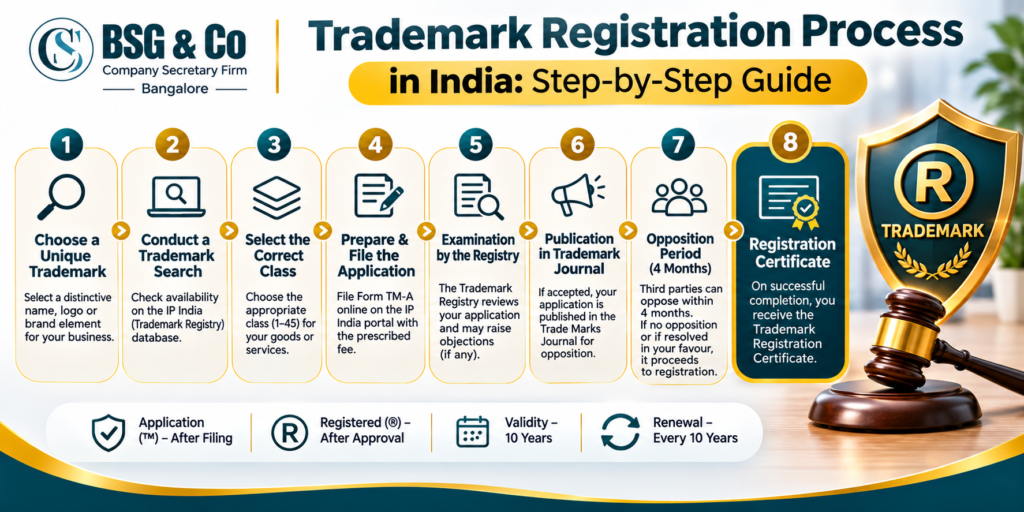
Step 1: Select a Unique Brand Name
The first step is selecting a distinctive name, logo or other brand element.
Avoid choosing names that are generic, descriptive without acquired distinctiveness, misleading or confusingly similar to existing trademarks.
A unique brand name improves the chances of successful registration and helps establish a recognisable business identity.
Step 2: Conduct a Trademark Search
Before submitting an application, conduct a trademark availability search through the official Intellectual Property India database.
The search should consider:
- Identical brand names
- Similar spellings
- Similar pronunciations
- Existing logo marks
- Related goods and services
- Relevant trademark classes
A preliminary search helps identify potential conflicts before spending money on an application.
However, finding no identical result does not automatically guarantee registration. Similarity, classification and other legal grounds must also be considered.
Step 3: Select the Appropriate Trademark Class
Identify the correct class based on the actual goods or services associated with the brand.
If the business operates in different sectors, evaluate whether separate applications or multiple classes are necessary.
Step 4: Prepare the Application
The application is generally filed using Form TM-A.
The applicant must provide relevant details, including:
- Applicant’s name and address
- Trademark representation
- Goods or services description
- Appropriate class
- Use status of the trademark
- Applicant category
The application should be checked carefully before submission.
Step 5: File the Trademark Application Online
The application can be submitted through the official Intellectual Property India e-filing portal.
After filing the prescribed government fee, the applicant receives an application number.
Once the application has been filed and the application number is generated, the applicant can generally use the symbol ™ in connection with the mark.
However, this does not mean the trademark has been registered.
Step 6: Trademark Examination
The Trademark Registry examines the application to determine whether it satisfies the requirements of the Trade Marks Act, 1999.
The examination may identify:
- Similar existing trademarks
- Lack of distinctiveness
- Descriptive or generic elements
- Incorrect classification
- Other statutory objections
If the Registry raises objections, the applicant may need to submit a written response with appropriate legal grounds and supporting documents.
A hearing may also be scheduled if required.
Step 7: Publication in the Trademark Journal
If the application is accepted, it is published in the Trade Marks Journal.
Publication provides an opportunity for third parties to oppose the proposed registration if they believe it conflicts with their legal rights.
The opposition period is four months from the date of advertisement.
Step 8: Opposition Proceedings, If Any
If another party files an opposition, the applicant must respond within the prescribed period.
The opposition process may involve:
- Filing a counterstatement
- Submission of evidence
- Supporting documents
- Written arguments
- Hearings before the Registrar
If no opposition is filed within the prescribed period, or an opposition is decided in favour of the applicant, the application may proceed towards registration, subject to the applicable requirements.
Step 9: Trademark Registration Certificate
Once all applicable formalities are completed and the application is approved, the Trademark Registry issues the registration certificate.
The owner can then use the ® symbol for the registered trademark in relation to the registered goods or services.
Registration provides statutory rights and helps the proprietor take appropriate legal action against infringement.
How Long Does Trademark Registration Take in India?
The time required for trademark registration varies depending on the application, examination, objections and opposition proceedings.
Some applications may progress without major complications, while others may take considerably longer because of examination objections or third-party opposition.
The process generally includes:
- Application submission
- Examination by the Trademark Registry
- Response to objections, if applicable
- Journal publication
- Opposition period
- Final registration
Applicants should regularly monitor the application status and respond to official communications within the prescribed timelines.
Filing an application does not guarantee registration within a fixed period.
Trademark Validity and Renewal in India
A registered trademark in India is valid for ten years from the date of application.
It can be renewed for successive periods of ten years by submitting the prescribed renewal application and fee.
The owner should maintain a record of renewal dates to avoid losing registration due to non-renewal.
Renewal is generally filed using Form TM-R.
If a trademark is not renewed within the prescribed period, it may be removed from the register, subject to applicable statutory procedures. Restoration may be possible in certain circumstances within the prescribed period.
Therefore, regular trademark monitoring and timely renewal are important responsibilities for every trademark owner.
Difference Between Trademark and Copyright
Many business owners confuse trademarks with copyrights. Although both are forms of intellectual property protection, they serve different purposes.
| Basis | Trademark | Copyright |
| Main Purpose | Protects brand identity | Protects original creative expression |
| Examples | Brand name, logo, slogan | Books, photographs, music, software code |
| Governing Law | Trade Marks Act, 1999 | Copyright Act, 1957 |
| Registration | Application through Trademark Registry | Registration is available through the Copyright Office |
| Protection | Depends on the registered mark and goods or services | Protects qualifying original works under copyright law |
A business may require both trademark and copyright protection. For example, its brand name may be protected through trademark registration, while its original website content, photographs and marketing materials may qualify for copyright protection.
Common Mistakes to Avoid During Trademark Registration
Businesses should avoid the following mistakes:
- Not conducting a trademark search: Filing without checking existing marks can increase the risk of objections or conflicts.
- Selecting a generic name: Common descriptive terms may not qualify for registration unless they meet the applicable distinctiveness requirements.
- Choosing the wrong class: Incorrect classification can leave important goods or services unprotected.
- Ignoring examination reports: Failure to respond to objections within the prescribed time can result in adverse consequences, including abandonment.
- Providing incorrect ownership details: The applicant should be the correct proprietor of the trademark.
- Claiming an incorrect usage date: Prior-use claims should be accurate and supported by appropriate evidence.
- Ignoring renewal deadlines: Failure to renew can lead to removal of the trademark from the register.
- Assuming application means registration: An application number does not mean the mark has been successfully registered.
Professional assistance can help businesses avoid common procedural mistakes and manage the registration process more effectively.
Why Choose BSG & CO for Trademark-Related Assistance in Bangalore?
Trademark protection is an important part of business compliance, brand development and intellectual property management.
BSG & CO is a Company Secretary firm in Bangalore offering professional support to businesses and entrepreneurs in corporate and compliance-related matters.
Businesses seeking trademark-related assistance can benefit from proper guidance on application preparation, documentation, ownership details, classification and procedural requirements.
The firm can assist clients with understanding the registration process, coordinating the required filing formalities and monitoring relevant compliance requirements, subject to the applicable professional authorisation and scope of services.
Whether you are a startup registering your first brand or an established company protecting an existing business identity, obtaining appropriate guidance can help you approach trademark registration with greater clarity.
Choosing the right trademark strategy at the beginning can save time, reduce avoidable complications and support long-term business growth.
Contact BSG & Co
Phone: +91-8660360492
Email: bhaskar@bhaskarbhatandco.in
Website: www.csfirmbsg.com
Address: 2nd Floor, 66, 13th Main Rd, 4th T Block East, 4th Block, Jayanagar, Bengaluru, Karnataka 560011
Conclusion
A trademark is more than a business name or logo. It represents your brand identity, customer recognition, business reputation and commercial value.
Registering a trademark in India helps businesses establish statutory rights over their distinctive brand elements and protect them against unauthorised use. From conducting an availability search and selecting the correct class to responding to examination objections and obtaining the registration certificate, every stage requires attention to detail.
Entrepreneurs, startups, small businesses and established companies should consider trademark protection as an important part of their business strategy.
If you are planning to register a new brand or protect an existing business identity, BSG & CO, Company Secretary Firm in Bangalore, can help you understand the relevant procedural and compliance requirements and guide you towards the appropriate professional support.
Protect your brand today. A strong business identity deserves the right legal protection.
Important official references
For legal accuracy, the article follows information published by the Indian Trademark Registry: