
Company Pvt Ltd Registration Guide for India
Starting a business involves more than developing a good idea. Entrepreneurs must also choose the right legal structure, understand their responsibilities and complete the required registration formalities. For many startups and growing businesses, a Private Limited Company is a preferred structure because it offers limited liability, a separate legal identity and better opportunities for growth.
Understanding the company pvt ltd registration process before starting can help entrepreneurs prepare documents correctly and avoid unnecessary delays. From selecting a suitable name to completing incorporation formalities and meeting post-registration obligations, every stage requires careful attention.
This guide explains the key requirements, documents, process, costs and compliance considerations involved in company pvt ltd registration in India.
What Is a Private Limited Company?
A Private Limited Company is a company incorporated under the applicable provisions of the Companies Act and administered through the Ministry of Corporate Affairs (MCA). It is treated as a separate legal entity from its shareholders and directors.
This means the company can own property, enter into contracts, earn income and incur liabilities in its own name. The personal liability of shareholders is generally limited to their investment or the amount unpaid on their shares, subject to applicable laws and circumstances.
Key characteristics include:
- Separate legal identity
- Limited liability protection
- Ownership through shares
- Perpetual succession
- Management through directors
- Ability to enter contracts in the company’s name
- A more formal structure for growing businesses
The owners of a company are generally its shareholders, while directors are responsible for managing and overseeing the company. In smaller companies, the same individuals may act as both shareholders and directors.
Because of its structured ownership and management framework, company pvt ltd registration is widely considered by startups, technology ventures and businesses planning long-term growth.
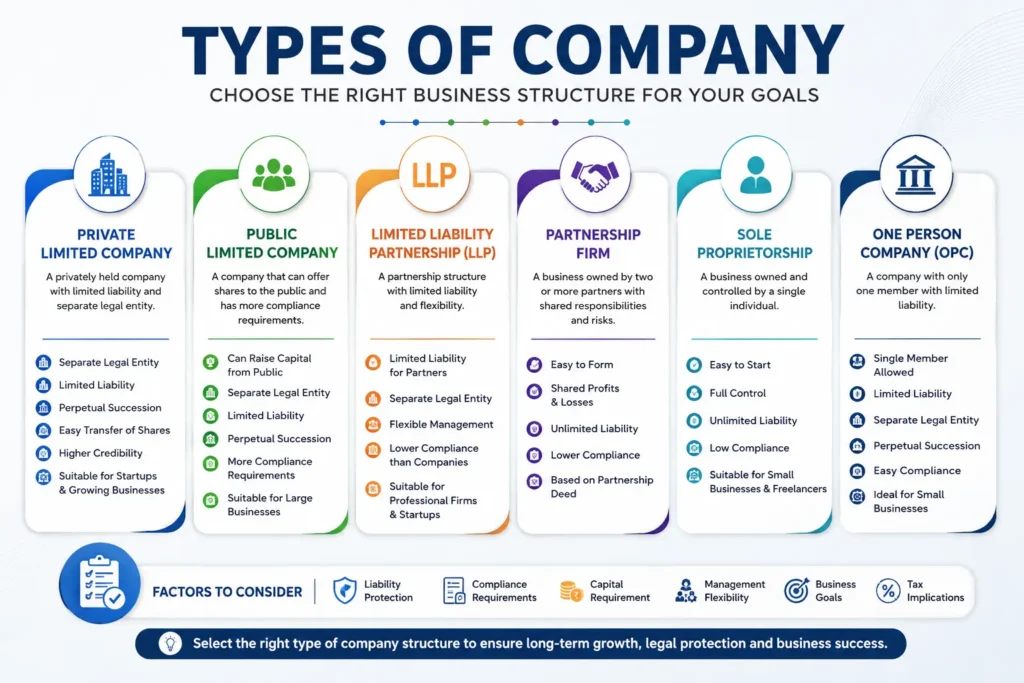
Why Choose a Private Limited Company?
A Private Limited Company offers several advantages for entrepreneurs who want a structured and scalable business model.
Limited Liability
One of the major benefits is limited liability. Shareholders generally have protection from personal liability beyond their agreed investment, subject to applicable legal provisions and exceptions.
Separate Legal Entity
The company has its own legal identity. It can acquire assets, enter contracts and conduct business independently of its owners.
Better Business Credibility
A registered company may create a stronger professional image among customers, vendors, financial institutions and potential business partners.
Ability to Raise Investment
Private Limited Companies are often preferred by investors because ownership can be structured through shares. This can make the business more suitable for equity investment, subject to applicable laws and agreements.
Easier Ownership Transfer
Shares can generally be transferred according to the company’s constitutional documents and applicable legal requirements.
Perpetual Succession
The company can continue to exist even if there is a change in shareholders or directors, subject to legal procedures.
Suitable for Scalable Businesses
For entrepreneurs expecting expansion, multiple founders or external investment, company pvt ltd registration can provide a more organised foundation.
Basic Eligibility for Company Pvt Ltd Registration
Before beginning the incorporation process, entrepreneurs should understand the basic requirements.
Generally, a Private Limited Company requires:
- At least two directors
- At least two shareholders
- At least one director meeting the applicable Indian residency requirement
- A registered office address in India
- Appropriate identity and address documents
- Digital signatures for electronic filings
- Compliance with applicable incorporation and MCA requirements
The same person can hold more than one role in the company. For example, a shareholder may also be a director.
Indian residents and foreign nationals may participate in a company structure, subject to applicable corporate, foreign exchange and other legal requirements. The exact requirements can vary depending on the ownership structure and business activity.
Anyone planning company pvt ltd registration should review the latest applicable rules because legal requirements and filing procedures may change.
Documents Required for Private Limited Company Registration
Preparing documents in advance can make the incorporation process smoother.
For Directors and Shareholders
Commonly required documents may include:
- PAN card for Indian nationals, where applicable
- Aadhaar card or another accepted identity document
- Passport for foreign nationals
- Address proof
- Recent photograph
- Email ID
- Mobile number
- Additional identity or residence documents, where required
For the Registered Office
The company generally needs evidence of its registered office. Depending on the premises, documents may include:
- Ownership proof
- Rental or lease agreement
- Recent utility bill
- No Objection Certificate (NOC), where applicable
- Other supporting documents required under the filing process
Additional documents may be necessary depending on the applicant, ownership structure, nationality of participants and nature of the proposed business.
Accurate documentation is an important part of company pvt ltd registration, as incomplete or inconsistent information can result in clarifications or resubmissions.
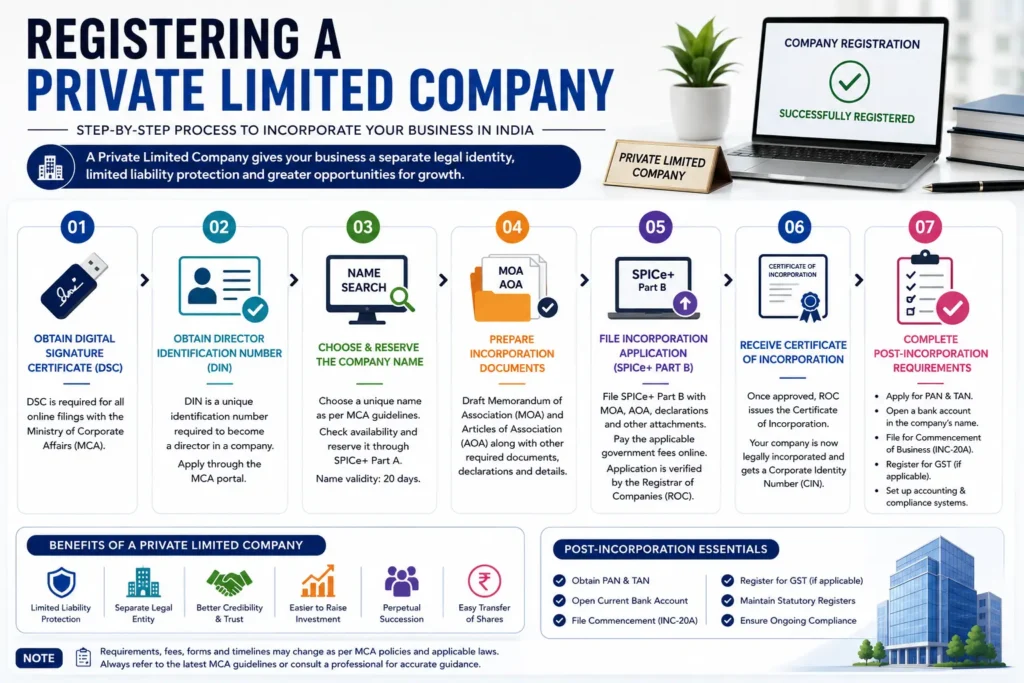
Step-by-Step Company Registration Process in India
The company incorporation process involves several connected stages.
Step 1: Obtain a Digital Signature Certificate
Since incorporation applications and related documents are filed electronically, eligible individuals may need a Digital Signature Certificate (DSC). Digital signatures are used to authenticate electronic documents and filings.
The DSC requirements depend on the individual and the filing process applicable at the time of incorporation.
Step 2: Obtain Director Identification Details
Individuals proposed to become directors must comply with applicable director identification requirements. Depending on the current MCA process, Director Identification Number (DIN)-related details may be obtained or applied for as part of the incorporation process.
It is important to provide correct personal information and supporting documents.
Step 3: Choose and Reserve the Company Name
Selecting the right name is an important part of company pvt ltd registration.
A proposed name should generally:
- Be sufficiently distinct
- Follow applicable naming rules
- Not be identical or too similar to an existing registered name
- Avoid restricted or misleading words unless appropriate approval is obtained
- Consider potential trademark conflicts
Entrepreneurs should not focus only on MCA name availability. A broader trademark review can also be useful before investing in branding, websites, packaging and marketing.
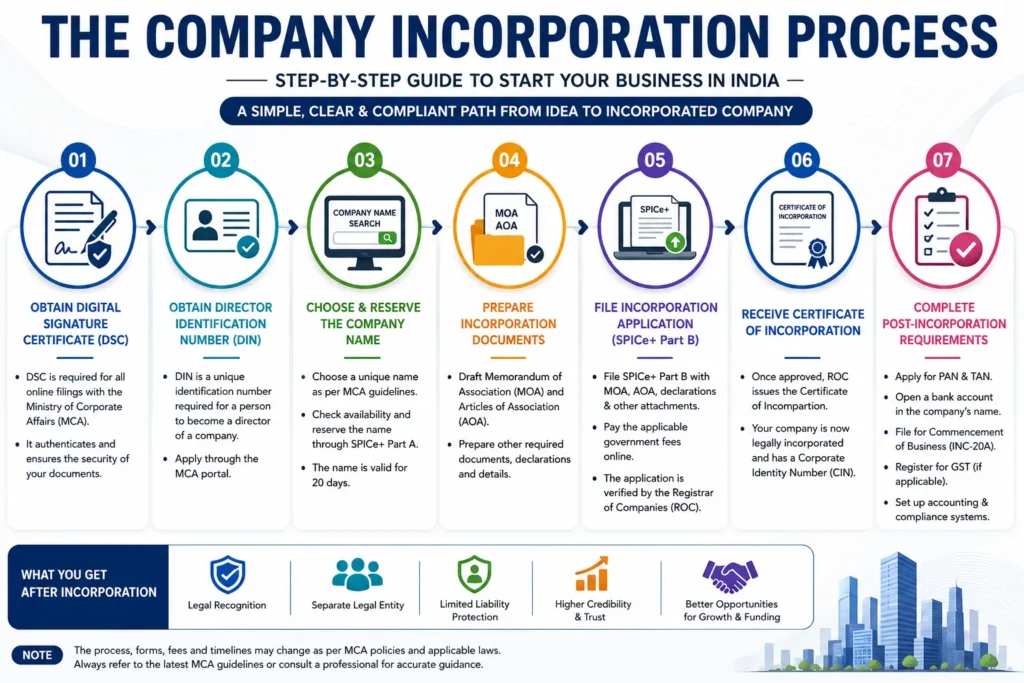
Step 4: Prepare Incorporation Documents
The next stage involves preparing the constitutional and incorporation documents.
Important documents generally include:
- Memorandum of Association (MOA)
- Articles of Association (AOA)
- Registered office details
- Director information
- Shareholder information
- Details of the proposed business activities
- Declarations and supporting documents required for incorporation
The MOA broadly sets out the company’s objectives and scope, while the AOA contains rules governing internal management and operations.
Step 5: File the Incorporation Application
The incorporation application is filed electronically through the Ministry of Corporate Affairs system along with the required forms, declarations and supporting documents.
The exact form structure and online procedures may change over time. Therefore, the latest MCA requirements should be checked before filing.
This stage is central to company pvt ltd registration, and accuracy is particularly important because incorrect information may lead to clarification requests or resubmission.
Step 6: Receive the Certificate of Incorporation
Once the application is approved, the Registrar of Companies issues a Certificate of Incorporation.
The certificate confirms that the company has been incorporated as a legal entity. The incorporation records generally include important identification details relating to the company.
The Certificate of Incorporation is a significant milestone, but entrepreneurs should remember that incorporation is not the end of their legal responsibilities.
Step 7: Complete Post-Incorporation Requirements
After incorporation, the company may need to complete several additional requirements, such as:
- Obtaining or confirming PAN and TAN details, where applicable
- Opening a company bank account
- Completing commencement-related requirements, where applicable
- Obtaining GST registration if required or eligible
- Setting up accounting and bookkeeping systems
- Maintaining statutory records
- Obtaining industry-specific licences or registrations
A properly planned company pvt ltd registration process should therefore include preparation for the period after incorporation as well.
How Long Does Company Registration Take?
There is no single guaranteed timeline for incorporation. The duration of company pvt ltd registration may depend on several factors.
These include:
- Availability and approval of the proposed company name
- Accuracy and completeness of documents
- Government processing time
- Clarifications raised during scrutiny
- Need for resubmission
- Availability of digital signatures
- Business-specific approvals
If all documents are properly prepared and no major clarification is required, the process may move more smoothly. However, entrepreneurs should avoid planning business commitments based on an assumed guaranteed approval date.
Cost of Registering a Private Limited Company
The cost of incorporation can vary significantly based on the facts of each case.
The overall cost may include:
- Government filing fees
- Professional fees
- Digital Signature Certificate expenses
- Stamp duty
- Authorised capital-related charges, where applicable
- Number of directors or subscribers
- State-specific requirements
- Additional registrations or licences
Therefore, there is no universal fixed cost for company pvt ltd registration. Entrepreneurs should ask for a clear breakdown of expected government and professional charges before proceeding.
Fees, filing procedures and regulations may change, so current requirements should always be verified.
Private Limited Company vs Other Business Structures
Choosing the right structure depends on the size, ownership model and future plans of the business.
Feature |
Private Limited Company |
LLP |
Partnership Firm |
Sole Proprietorship |
| Liability | Generally limited | Generally limited | Depends on structure and agreement | Usually unlimited |
| Legal status | Separate legal entity | Separate legal entity | May vary by applicable law | No separate entity from owner |
| Ownership | Shares | Partners | Partners | Single owner |
| Compliance | Relatively higher | Moderate | Generally lower | Generally simpler |
| Investment potential | High | Moderate | Limited | Limited |
| Startup suitability | Strong | Suitable for many businesses | Suitable for smaller ventures | Suitable for individual businesses |
Entrepreneurs considering company pvt ltd registration should compare future funding plans, compliance capacity, number of founders and long-term business goals before selecting a structure.
Common Mistakes to Avoid During Registration
The incorporation process may appear straightforward, but common mistakes can create delays or future compliance problems.
Choosing a Name Without Proper Checks
A name may be rejected if it is too similar to an existing company name or does not meet applicable naming requirements.
Ignoring Trademark Issues
MCA approval and trademark registration are different matters. A name may still create branding or intellectual property concerns.
Submitting Incorrect Documents
Mismatched names, outdated address proof or incomplete documents can lead to clarification requests.
Using an Unsuitable Registered Office Address
The company should have proper documentary support for the registered office address.
Not Understanding Compliance Responsibilities
Incorporation creates ongoing obligations. Entrepreneurs should understand the expected annual and event-based compliance requirements.
Choosing the Wrong Structure
Not every business needs the same legal structure. A decision should be based on ownership, risk, investment plans and operational needs.
Ignoring Post-Incorporation Requirements
Completing company pvt ltd registration is only the first stage. Banking, accounting, tax and statutory requirements must also be addressed.
Post-Registration Compliance Requirements
Company registration is the beginning of an ongoing compliance journey.
Depending on the company and applicable laws, obligations may include:
- Annual MCA filings
- Preparation and filing of financial statements
- Income tax compliance
- Maintenance of statutory registers and records
- Board and shareholder-related requirements
- Auditor-related obligations
- GST compliance, where applicable
- TDS requirements, where applicable
- Labour law and employment-related compliance
- Industry-specific licences and registrations
The exact company compliance requirements depend on factors such as turnover, business activity, employee strength, location and applicable legislation.
Entrepreneurs should build compliance planning into the business from the beginning rather than treating it as an afterthought.
Who Should Consider Registering a Private Limited Company?
A Private Limited Company may be suitable for:
- Startup founders
- Technology and digital businesses
- Businesses planning to raise investment
- Companies with multiple founders
- Growing businesses with expansion plans
- Businesses seeking stronger market credibility
- Entrepreneurs planning long-term operations
- Businesses that may introduce new shareholders in the future
For these businesses, company pvt ltd registration can provide a formal structure for ownership, management and future growth.
However, a Private Limited Company may not be the right choice for every entrepreneur. Compliance costs and administrative responsibilities should be considered before making a decision.
Frequently Asked Questions About Company Pvt Ltd Registration
-
What is required for company pvt ltd registration in India?
company pvt ltd registration generally requires eligible directors and shareholders, a registered office address, identity and address documents, digital signatures and incorporation documents, subject to current applicable rules.
-
How many directors are required for a Private Limited Company?
Generally, at least two directors are required. At least one director must meet the applicable Indian residency requirement.
-
Can one person start a Private Limited Company?
A traditional Private Limited Company generally requires at least two shareholders and directors as applicable. A person wishing to operate alone may consider whether a One Person Company or another structure is more suitable, subject to current legal provisions.
-
Is a registered office mandatory?
Yes, a company generally requires a registered office address in India for incorporation and official communication purposes.
-
How long does company registration usually take?
The timeline varies depending on document readiness, name approval, government processing and whether any clarification or resubmission is required.
-
What documents are required for directors?
Common documents include identity proof, PAN where applicable, address proof, photograph, email ID and mobile number. Foreign nationals may need additional documents such as a passport and other authenticated records.
-
What are the compliance requirements after incorporation?
Requirements may include annual filings, financial statements, tax compliance, statutory records, board-related obligations, GST compliance where applicable and industry-specific requirements.
Conclusion
Starting a company is an important business decision, and understanding the incorporation process can help entrepreneurs begin with greater clarity. company pvt ltd registration offers several benefits, including a separate legal identity, limited liability and a structured platform for business growth.
Before proceeding, entrepreneurs should prepare documents carefully, select the appropriate business structure, choose a compliant and distinctive company name and understand the responsibilities that continue after incorporation.
It is also important to remember that legal requirements, government fees, filing procedures and regulations may change. Professional guidance can be useful when the ownership structure, business activity or compliance requirements are complex.
A well-planned company pvt ltd registration process can help create a stronger foundation for a startup or growing business while ensuring that important legal and administrative requirements are addressed appropriately.
Get Professional Assistance
Entrepreneurs who need guidance on incorporation procedures, documentation and related corporate compliance matters can seek professional assistance based on their specific business requirements.
BSG & Co provides professional assistance for entrepreneurs and businesses seeking guidance on company registration and related corporate compliance requirements.
Phone: +91-8660360492
Email: bhaskar@bhaskarbhatandco.in
Website: www.csfirmbsg.com
Address: 2nd Floor, 66, 13th Main Rd, 4th T Block East, 4th Block, Jayanagar, Bengaluru, Karnataka 560011
For guidance tailored to your proposed business structure and compliance requirements, contact the firm to discuss the appropriate next steps.