
How to Register a Startup in India: Complete Step-by-Step Guide
Starting a business in India involves much more than choosing a business name and beginning operations. Founders need to select an appropriate legal structure, prepare the required documents, complete applicable government registrations and understand the compliance responsibilities that continue after incorporation.
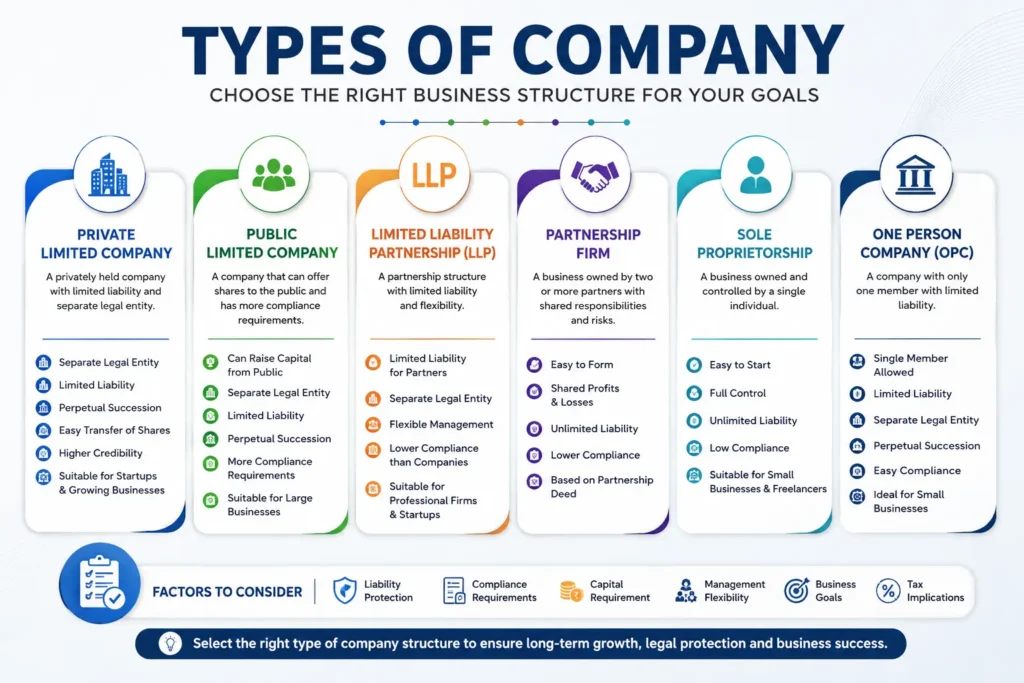
If you are planning to register a startup, one of the first decisions is choosing the right business structure. Depending on the nature of the business, founders may consider a Private Limited Company, Limited Liability Partnership (LLP), Partnership Firm or Sole Proprietorship.
Many growth-oriented startups consider a Private Limited Company because it provides a structured ownership framework, share-based ownership and a corporate structure that can accommodate equity investment. However, a Private Limited Company is not automatically suitable for every startup. The right structure depends on the founders, business model, liability considerations, investment plans and long-term objectives.
It is equally important to understand that company incorporation and Startup India recognition are two different processes. Incorporation establishes the legal business entity, while eligible businesses may separately apply for recognition under the DPIIT Startup India framework.
This guide explains how to register a startup in India, including business structures, documents, the MCA incorporation process, costs, timelines, GST, Startup India recognition and post-registration compliance.
What Does It Mean to Register a Startup?
In simple terms, startup registration means legally establishing a business and completing the registrations and approvals applicable to its activities.
The term “startup registration” can sometimes create confusion because several different processes may be involved.
These can include:
- Incorporating a business entity
- Obtaining tax registrations
- Obtaining sector-specific licences
- Applying for Startup India/DPIIT recognition where eligible
These processes are not interchangeable.
For example, incorporating a Private Limited Company creates a company under the Companies Act, 2013. The Ministry of Corporate Affairs (MCA) administers the corporate registration framework, while the Registrar of Companies (ROC) maintains statutory company records and handles applicable filings.
Startup India recognition is a separate process. Eligible entities can apply for recognition under the DPIIT Startup India framework, subject to the applicable eligibility criteria.
Therefore, entrepreneurs should understand that Startup India recognition does not itself create a company.
Before you register a startup, it is important to determine which legal structure is appropriate and which additional registrations are relevant to the business.
Choose the Right Business Structure Before You Register a Startup
The first major decision is selecting the legal structure.
| Business Structure | Suitable For | Liability | Ownership | Investment Potential |
| Private Limited Company | Scalable startups | Limited, subject to applicable law | Shareholders | Generally suitable for equity investment |
| LLP | Professional and service businesses | Limited, subject to applicable law | Partners | Different from company equity |
| Partnership Firm | Small businesses | Generally unlimited | Partners | More limited than company equity |
| Sole Proprietorship | Individual businesses | Unlimited | Single owner | Limited |
Private Limited Company
A Private Limited Company may be suitable for founders who want share-based ownership and a formal corporate structure. It can also provide a framework for bringing in equity investors.
Limited Liability Partnership
An LLP combines elements of partnership management with limited liability. It may be appropriate for certain professional, consulting and service-oriented businesses.
Partnership Firm
A partnership can be suitable for smaller businesses operated by two or more partners. However, partners should understand the liability implications before selecting this structure.
Sole Proprietorship
A sole proprietorship is owned and operated by one individual. It can be relatively simple to establish, but the proprietor and business generally do not have separate legal identities.
The appropriate structure should therefore be selected based on the startup’s actual requirements rather than simply choosing the structure that is most commonly associated with startups.
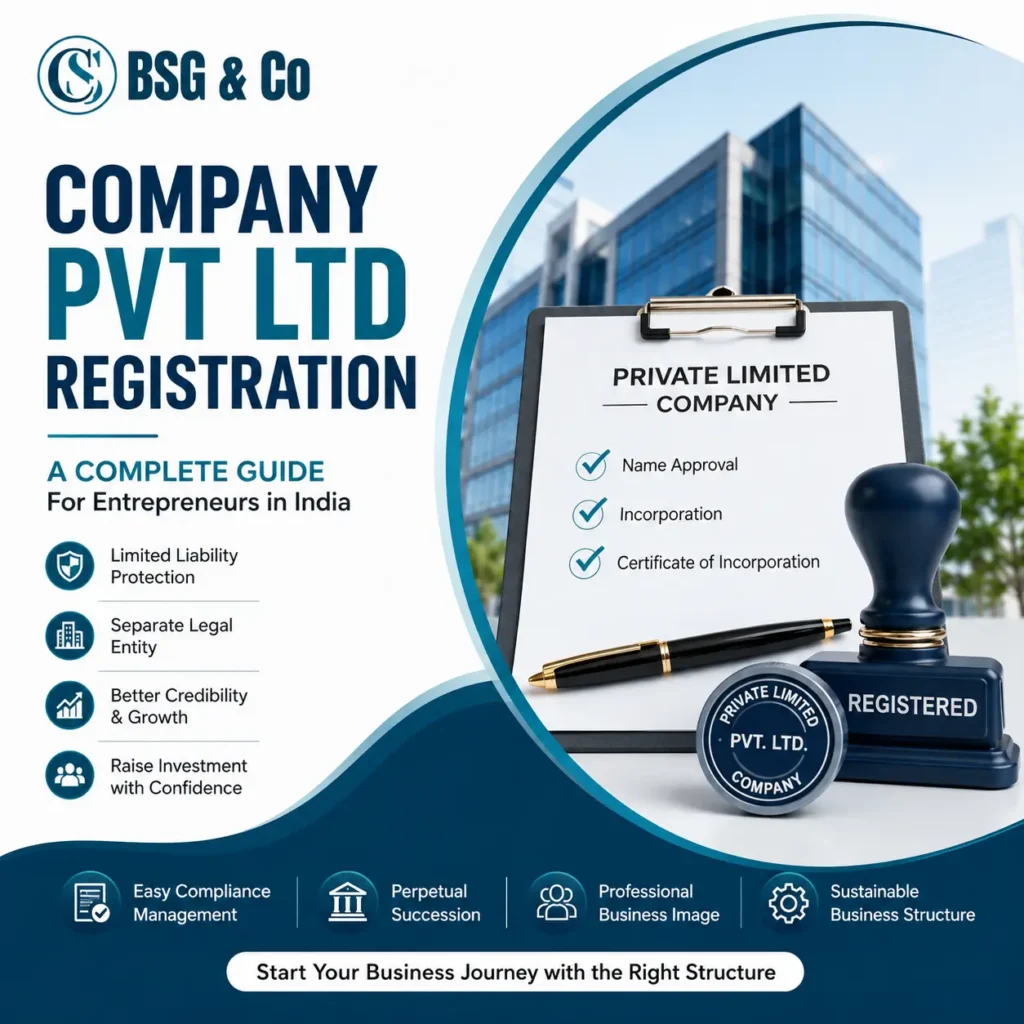
Why Register a Startup as a Private Limited Company?
For many scalable businesses, Private Limited Company incorporation can provide a structured corporate framework.
Separate Legal Entity
A company has a legal identity separate from its members. This allows the business to operate as a distinct legal entity.
Limited Liability
Shareholders generally have limited liability according to the legal structure and applicable law. However, incorporation does not eliminate every possible personal liability or legal responsibility.
Fundraising
A company structure can be useful for startups planning to raise equity investment because ownership can be represented through shares.
Ownership Through Shares
Founders can establish a shareholding structure representing their agreed ownership percentages.
Business Credibility
Formal incorporation can provide a recognised corporate identity when dealing with customers, vendors, financial institutions, investors and other stakeholders.
Continuity
A company has continuity that is separate from changes involving individual shareholders, subject to applicable corporate law.
These characteristics can make a Private Limited Company suitable for certain startups, but founders should evaluate their individual circumstances before making the decision.
Who Can Register a Startup in India?
Indian residents, entrepreneurs, professionals and groups of co-founders can establish businesses in India subject to applicable legal requirements.
NRIs and foreign individuals or entities may also participate in Indian businesses, subject to applicable foreign investment rules, sector-specific regulations, taxation requirements and other laws.
Founders should pay particular attention to the structure when foreign shareholders or directors are involved.
For a Private Limited Company, the Companies Act, 2013 establishes requirements concerning members and directors. The precise requirements can depend on the type of entity being incorporated and the circumstances of the founders.
Professional advice can be useful where the proposed startup has foreign ownership, regulated activities, complex shareholding or specialised investment arrangements.
Requirements to Register a Startup in India
Before you register a startup, it is useful to prepare a checklist of information and documents.
Common requirements can include:
- Proposed company name
- Main business activity
- Registered office address
- Director details
- Shareholder/subscriber details
- PAN
- Identity proof
- Address proof
- Photographs
- Email address
- Mobile number
- Digital Signature Certificate (DSC)
- Applicable director identification details
- Shareholding structure
- Capital structure
- Memorandum of Association (MOA)
- Articles of Association (AOA)
- Required declarations
- Other supporting documents
The exact requirements can vary depending on the legal structure, founders, registered office and nature of the proposed business.
MCA incorporation procedures and forms can also be updated from time to time, so current requirements should be verified before filing.
Documents Required to Register a Startup
Having the required documents ready can make the incorporation process more organised.
Documents for Directors and Shareholders
Common documents may include:
- PAN card
- Aadhaar, passport or another accepted identity document
- Address proof
- Recent photograph
- Email ID
- Mobile number
Foreign directors or shareholders may have additional documentation requirements.
Documents for the Registered Office
Depending on the circumstances, documents may include:
- Ownership proof
- Rent or lease agreement
- Owner’s No Objection Certificate (NOC), where applicable
- Utility bill or other accepted address evidence
Company Formation Documents
The incorporation process may require:
- Proposed company names
- Main business activities
- Shareholding details
- Director details
- MOA
- AOA
- Applicable declarations
- Other supporting documents
Founders should ensure that information across all documents is consistent.
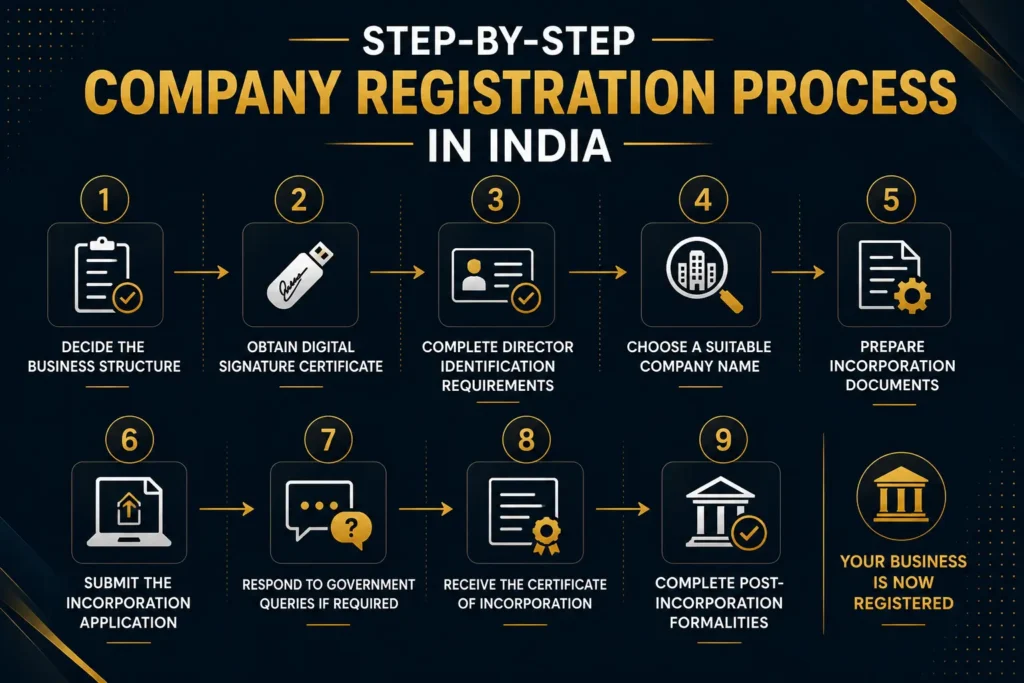
Step-by-Step Process to Register a Startup in India
Step 1: Decide the Business Structure
Start by determining whether a Private Limited Company, LLP, partnership or another structure is appropriate.
Consider:
- Number of founders
- Liability
- Business activity
- Ownership
- Investment plans
- Tax considerations
- Future expansion
Step 2: Decide the Founders and Shareholding
For a startup with multiple founders, decide the initial ownership percentages and capital contributions.
This is also a good stage to discuss roles, responsibilities and decision-making arrangements.
Step 3: Obtain Digital Signature Certificates
Digital signatures are used for electronic submission and authentication of applicable government forms.
The relevant directors or subscribers may need DSCs depending on the incorporation process.
Step 4: Select a Company Name
Select a suitable name for the proposed company and check its availability and acceptability.
Founders should also consider potential trademark conflicts before investing heavily in branding.
Step 5: Prepare Incorporation Documents
Prepare the MOA, AOA, declarations, subscriber information, director information and other applicable documentation.
The MOA generally sets out the company’s principal objects, while the AOA contains rules concerning internal management.
Step 6: File the Incorporation Application
The applicable incorporation application is submitted through the MCA system.
The information should be reviewed carefully before submission. Incorrect or incomplete information may lead to queries or resubmission requirements.
Step 7: Provide Registered Office Details
The company needs to comply with applicable registered-office requirements.
Founders should ensure that the proposed address is appropriate and that supporting documentation is available.
Step 8: Receive the Certificate of Incorporation
After successful processing, the company receives its Certificate of Incorporation.
This establishes the company as an incorporated legal entity.
Step 9: Obtain PAN and TAN
PAN is important for the company’s tax and financial activities.
TAN becomes relevant where the company has applicable tax deduction or collection obligations.
Step 10: Open a Business Bank Account
The company can establish a business bank account after incorporation and completion of the bank’s applicable documentation and verification requirements.
Step 11: Complete Applicable Tax Registrations
Depending on the startup’s activities, GST and other registrations may be applicable.
GST should not be treated as an automatic requirement for every newly incorporated startup.
Step 12: Consider Startup India Recognition
Once the appropriate entity has been established, an eligible startup can consider applying for DPIIT Startup India recognition.
Recognition is subject to the applicable criteria and is separate from incorporation.
Step 13: Complete Post-Incorporation Compliance
Founders must understand that incorporation is only the beginning.
The company may have ongoing obligations involving:
- Statutory registers
- Accounting
- Board meetings
- Annual filings
- Tax compliance
- GST compliance
- Auditor-related requirements
- Share certificates
- Event-based filings
Startup India Recognition vs Company Registration
Understanding this distinction is essential for anyone researching how to register a startup.
| Factor | Company Registration | Startup India Recognition |
| Purpose | Creates the legal business entity | Provides recognition to eligible startups |
| Authority/Framework | MCA and applicable corporate law | DPIIT / Startup India framework |
| Result | Incorporated entity | Recognition if eligible |
| Creates a company? | Yes | No |
| Eligibility | Based on applicable incorporation requirements | Subject to Startup India criteria |
Startup India recognition and company incorporation are not the same thing.
An entrepreneur cannot treat Startup India recognition as a substitute for establishing the appropriate legal entity.
Eligible entities can separately seek recognition under the Startup India framework. The eligibility criteria and recognition process should be checked against current official requirements at the time of application.
Startup Registration Through MCA
The Ministry of Corporate Affairs (MCA) plays a central role in company incorporation and corporate compliance in India.
The MCA framework covers processes involving:
- Company name
- Incorporation applications
- Directors
- Subscribers/shareholders
- MOA
- AOA
- Digital signatures
- Government forms
- Certificate of Incorporation
- Statutory company records
The Registrar of Companies (ROC) plays an important role in maintaining company records and administering applicable statutory filings.
The MCA filing system and forms may be updated from time to time. Therefore, founders should use the current MCA requirements when preparing an incorporation application.
How Much Does It Cost to Register a Startup?
There is no single fixed cost applicable to every startup.
The overall startup registration fees and expenses can include:
| Cost Component | Possible Expense |
| Government filing fees | Applicable incorporation charges |
| Stamp duty | State-specific charges |
| DSC | Digital signature costs |
| Professional fees | CS, CA, lawyer or consultant fees |
| Name-related charges | Applicable charges |
| Tax registrations | Where applicable |
| Licences | Depending on business activity |
The total cost can vary based on:
- State
- Entity type
- Capital structure
- Number of directors
- Documentation
- Government charges
- Professional assistance
- Additional registrations
Therefore, entrepreneurs should avoid relying on a generic fixed figure when calculating the cost to register a startup.
How Long Does It Take to Register a Startup?
There is no universal guaranteed timeline for startup incorporation.
The time required can depend on:
- Document readiness
- Name availability
- Accuracy of information
- MCA processing
- Government queries
- Resubmission requirements
- Registered office documentation
- Complexity of the proposed structure
If documents are incomplete or information needs correction, additional time may be required.
A professional service provider can help organise the documentation and filing process, but government processing timelines should not be guaranteed.
Post-Registration Compliance for a Startup
Incorporation does not mean that the company’s compliance obligations are complete.
Depending on the entity and circumstances, a startup may need to manage:
- Statutory registers
- Accounting records
- Board meetings
- Annual filings
- Income-tax compliance
- GST compliance where applicable
- TDS compliance where applicable
- Auditor appointment
- Share certificates
- Bank records
- Financial records
- Event-based filings
- Director-related compliance
The exact compliance calendar depends on the company and applicable laws.
A startup should therefore establish a compliance system from the beginning instead of waiting until a filing deadline approaches.
Common Mistakes When Registering a Startup
- Choosing the Wrong Legal Structure
Founders sometimes choose a structure without considering investment plans, liability, ownership and future growth.
- Selecting a Problematic Company Name
A proposed name may create issues if it conflicts with existing names or trademarks.
- Incorrect Founder or Shareholding Details
Ownership percentages and subscriber information should be reviewed carefully before filing.
- Using Incomplete Documents
Missing or inconsistent documents can result in delays or queries.
- Ignoring Registered Office Requirements
The registered office should meet applicable requirements and have appropriate supporting documentation.
- Ignoring Post-Incorporation Compliance
A company continues to have legal and statutory obligations after incorporation.
- Assuming Incorporation Equals Startup India Recognition
Company incorporation and DPIIT recognition are separate processes.
- Ignoring Tax Requirements
GST, TDS and income-tax requirements should be evaluated based on the business’s circumstances.
- Not Documenting Founder Arrangements
Co-founders should consider documenting ownership, roles and decision-making.
- Failing to Maintain Statutory Records
Corporate records should be maintained as required by applicable law.
- Ignoring Intellectual Property
Company incorporation does not automatically protect a startup’s brand, software, invention or other intellectual property.
- Focusing Only on Registration
The long-term success of a company also requires appropriate accounting, tax, corporate and operational compliance.
Do Startups Need GST Registration?
Not every startup needs GST registration immediately.
The requirement depends on factors such as:
- Turnover
- Nature of supplies
- Business activity
- Location
- Applicable GST provisions
- Specific circumstances that may trigger registration
Certain categories of businesses can have GST registration obligations based on provisions other than a simple turnover threshold.
Therefore, founders should evaluate their specific business activities rather than assuming that incorporation automatically requires GST registration.
Professional tax advice can be useful where the GST position is complex.
Startup Registration and Intellectual Property
A startup’s legal identity and its intellectual property rights are separate matters.
Founders should consider:
Trademark Registration
A trademark can help protect eligible brand names, logos and other distinctive marks.
Copyright
Copyright protection may be relevant to original software, written content, graphics, creative material and other eligible works.
Patent Protection
Technology or inventions may qualify for patent protection if the applicable legal requirements are satisfied.
Domain Name
A suitable domain name can form an important part of the startup’s online identity.
IP Ownership Agreements
Startups should ensure that intellectual property created by founders, employees, contractors or agencies is appropriately assigned or licensed.
Company incorporation does not automatically provide comprehensive trademark or intellectual property protection.
Founder Agreement and Shareholding Structure
When two or more founders start a business together, documenting their relationship can be extremely important.
A founders’ agreement or shareholders’ agreement may address:
- Ownership percentages
- Founder roles
- Capital contributions
- Decision-making
- Intellectual property ownership
- Exit arrangements
- Share transfer restrictions
- Confidentiality
- Dispute resolution
For example, if one founder contributes technology and another contributes capital, the parties should clearly document how ownership and responsibilities will work.
A well-considered shareholding structure can also help when the startup later discusses external investment.
Register a Startup in Bangalore
Entrepreneurs searching for startup registration in Bangalore can seek professional assistance for company incorporation, documentation and corporate compliance.
Bangalore has a large business and startup ecosystem, with entrepreneurs operating across areas such as Koramangala, Indiranagar, Whitefield, HSR Layout, Electronic City and Yelahanka.
However, the legal requirements for incorporation depend primarily on the chosen business structure and applicable laws rather than the particular neighbourhood where the founder operates.
Common searches include:
- Register a startup in Bangalore
- Startup registration services in Bangalore
- Company registration in Bangalore
- Startup consultant in Bangalore
- Company Secretary in Bangalore
- Corporate compliance services Bangalore
Startup Registration Support in Jayanagar
For founders based in South Bangalore, BSG & Co provides a local professional option for entrepreneurs seeking assistance with startup incorporation and corporate compliance requirements.
Contact BSG & Co
Phone: +91-8660360492
Email: bhaskar@bhaskarbhatandco.in
Website: www.csfirmbsg.com
Address: 2nd Floor, 66, 13th Main Rd, 4th T Block East, 4th Block, Jayanagar, Bengaluru, Karnataka 560011
Founders can discuss their proposed business structure, incorporation documentation and applicable compliance requirements with the firm.
How a Professional Can Help You Register a Startup
Professional assistance can make the incorporation process easier to organise, particularly for first-time founders.
Structure Selection
A professional can help founders understand the differences between a Private Limited Company, LLP and other structures.
Documentation
Professional support can help coordinate the required incorporation documents and identify missing information.
Filing Support
A Company Secretary or other appropriately qualified professional can assist with applicable MCA documentation and filing procedures.
Compliance Planning
After incorporation, founders can receive guidance on statutory filings, records and other ongoing requirements.
Startup Recognition Guidance
Professional assistance can help founders understand the separate DPIIT Startup India recognition process and applicable eligibility requirements.
Ongoing Corporate Compliance
Startups may also require continuing assistance with statutory filings, corporate records and event-based compliance.
Professional assistance should be viewed as support for navigating the applicable process. Government approval, incorporation timing and Startup India recognition should not be presented as guaranteed outcomes.
Who Should Consider Professional Startup Registration Assistance?
Professional assistance may be useful for:
- First-time founders
- Multiple-founder startups
- Technology startups
- Product startups
- Service businesses
- Businesses seeking investment
- Family businesses transitioning to corporate structures
- Startups planning expansion
- Businesses requiring structured compliance
- Founders unfamiliar with MCA procedures
The need for professional assistance depends on the complexity of the proposed business and the founders’ familiarity with corporate compliance.
Frequently Asked Questions
- How do I register a startup in India?
To register a startup, first choose an appropriate legal structure, determine the founders and shareholding, prepare the required documents, obtain applicable digital signatures and complete the relevant government incorporation process. After incorporation, assess tax, licensing and Startup India recognition requirements.
- Can I register a startup online?
Yes. Company incorporation applications can be submitted electronically through the MCA system, subject to the applicable requirements and documentation.
- What is the best structure for a startup?
There is no universally suitable structure. A Private Limited Company may suit startups seeking share-based ownership and potential equity investment, while an LLP or another structure may be appropriate for different businesses.
- How much does it cost to register a startup?
The cost varies according to the entity type, state, capital structure, government charges, DSC requirements, documentation and professional fees.
- How long does startup registration take?
There is no universal guaranteed timeline. Processing can depend on document readiness, name availability, government processing, queries and resubmission requirements.
- What documents are required to register a startup?
Common documents include PAN, identity and address proof, photographs, director and shareholder information, registered office documents, DSCs, MOA, AOA and applicable declarations.
- Can two people register a startup together?
Yes. Two or more founders can establish a business together, subject to the requirements of the selected legal structure.
- Can foreigners start a company in India?
Foreign individuals and entities can participate in Indian businesses subject to applicable foreign investment rules, sectoral restrictions, taxation and other legal requirements.
- Is Startup India registration the same as company registration?
No. Company incorporation creates the legal entity. DPIIT Startup India recognition is a separate process for entities that satisfy the applicable eligibility criteria.
- Does every startup need GST registration?
No. GST registration depends on applicable law, turnover, business activity and other circumstances. Certain situations can create registration requirements independently of a simple turnover test.
- Can a Company Secretary help register a startup?
Yes. A Company Secretary can assist with applicable incorporation documentation, corporate law procedures and ongoing compliance within their professional scope.
- Can I register a startup in Bangalore?
Yes. Entrepreneurs in Bangalore can establish an appropriate business entity through the applicable government process and comply with registered office and other requirements.
- Do I need a registered office for my startup?
An incorporated company must comply with applicable registered-office requirements. Appropriate address documentation should be maintained.
- What should I do after registering my startup?
After incorporation, founders should establish banking and accounting arrangements, assess GST and other tax requirements, maintain corporate records, complete applicable statutory filings, consider intellectual property protection and evaluate Startup India recognition if eligible.
Conclusion
To register a startup in India, founders need to look beyond the initial incorporation process. The journey begins with selecting the appropriate legal structure and establishing a clear understanding of the founders, ownership, business activity and future objectives.
For a company, incorporation involves preparing the required documentation and completing applicable MCA procedures under the Companies Act, 2013. After incorporation, the startup may need tax registrations, sector-specific licences, intellectual property protection and ongoing corporate compliance.
It is also important to remember that Startup India/DPIIT recognition is separate from company incorporation. An eligible business can consider applying for recognition after establishing the appropriate legal entity.
Correct entity selection, proper documentation, an agreed shareholding structure, accurate MCA filings and a planned compliance calendar can help create a strong legal foundation for a growing business.
Planning to Register a Startup in India?
Professional assistance can help founders understand the applicable business structure, incorporation documentation, MCA procedures and post-registration compliance requirements.
BSG & Co can assist entrepreneurs seeking professional guidance regarding startup incorporation and corporate compliance.
Contact BSG & Co
Phone: +91-8660360492
Email: bhaskar@bhaskarbhatandco.in
Website: www.csfirmbsg.com
Address: 2nd Floor, 66, 13th Main Rd, 4th T Block East, 4th Block, Jayanagar, Bengaluru, Karnataka 560011
Pvt Limited vs LLP: Complete Guide to Choosing the Right Business Structure
Director Appointment in India: Unlock a Smooth & Compliant Process
Fund Raising for Startup: The Powerful Guide to Raising Capital in India
Company Registration in India: Your Complete Roadmap to Success